
An online bachelor's degree costs between $6,000 and $48,600 per year in sticker tuition, but the actual cost depends on your residency, student fees, and financial aid. Nationally, the median average net price after grants at four-year colleges is $19,835 according to CollegesRef data. To find your true cost, you must calculate the price per credit hour, add mandatory distance-learning fees, and subtract your federal aid package.
This calculation is critical for adult learners and transfer students who often balance part-time enrollment with employment. Many applicants mistakenly assume that studying from home eliminates campus overhead and results in a cheaper degree. However, online students frequently pay specialized technology fees that do not apply to on-campus undergraduates. Public universities also vary in how they charge out-of-state online students, with some offering flat e-tuition rates and others charging full out-of-state tuition. Understanding these pricing structures prevents unexpected bills before graduation.
Key takeaways
- The national median net price for a four-year college is $19,835 after accounting for federal and institutional grant aid.
- Public colleges offer a median net price of $10,516, whereas private nonprofit and for-profit institutions exceed $27,000.
- Dependent undergraduates face a lifetime federal student loan limit of $31,000, according to studentaid.gov guidelines.
- Independent undergraduate students can access up to $57,500 in total federal student loans to fund their degrees.
- The maximum Federal Pell Grant for the 2026-27 award year is capped at $7,395 for eligible students.
How Online College Tuition Per Credit Translates to Real Costs
Calculating the Base Cost of a 120-Credit Degree
Online universities almost always price their programs by the credit hour rather than charging a flat semester rate. To earn an online bachelor's degree, a student must typically complete 120 semester credits. If an online program advertises a specific rate per credit, the baseline tuition is calculated by multiplying that rate by 120.
This baseline assumes a student starts with zero credits and completes every class at that single institution. An applicant can lower this cost by transferring existing credit from a community college or earning credit through Advanced Placement exams. Most institutions limit how many transfer credits they will accept. This limit is usually 60 credits for associate degree transfers and up to 90 credits from four-year institutions.
Before enrolling, request an official transfer credit evaluation from the registrar's office. Do not rely on informal estimates from an admissions representative. If you are comparing technical paths, such as analyzing Data Science vs Computer Science Degrees: Coursework and Careers, check if specific technical certifications translate into course waivers on your official evaluation.
How Part-Time Enrollment Alters Your Final Bill
Taking fewer than 15 credits per semester extends the time it takes to graduate. While a full-time student might finish in four years, a part-time student taking six credits per term will need ten years to complete 120 credits.
This slower pace changes financial calculations in three ways:
- Tuition inflation: Most colleges raise their per-credit tuition rates annually. A rate locked in today will likely be higher in year five.
- Recurring term fees: Many online programs charge technology, registration, or student services fees every single term. More terms online means paying these fees more times.
- Aid eligibility changes: To qualify for federal student loans, a student must enroll at least half-time, which usually means at least six credits per semester. Dropping below this threshold pauses loan eligibility and triggers the grace period for existing loans.
To see how these variables affect an overall budget, families can use the CollegesRef College Cost Estimator. This tool generates a four-year cost estimate using a college's sticker price and average net price, though it does not guarantee final individual costs.
To calculate a true baseline, multiply the current per-credit rate by the number of credits still needed after the official transfer evaluation. Add the annual tuition increase rate to the credits planned for later years. This formula gives a realistic starting point before adding mandatory fees.
Hidden Fees That Inflate the Sticker Price of Online Degrees
Sticker price comparisons often fail because online programs isolate administrative costs into separate, mandatory fees. These charges do not appear in the base per-credit tuition rate. When reviewing an online program, a student must request an itemized cost of attendance sheet from the financial aid office. This document lists all non-tuition charges that will appear directly on the university bill.
Distance Education and Technology Fees
Many public and private universities assess a flat distance education fee per semester, or a recurring technology fee per credit hour. This fee supposedly covers the cost of maintaining learning management systems like Canvas or Blackboard. For example, if a university charges a technology fee per credit hour, a student taking a standard 12-credit semester faces an extra charge that scales quickly. Over a 120-credit degree program, this single fee adds thousands of dollars to the total cost.
Some institutions also charge online students a general university fee. This fee covers physical campus resources like student unions, athletic facilities, and transit systems. Online students rarely use these services, but universities often apply the fee universally to all enrolled undergraduates.
When evaluating options, an applicant should ask the billing office if online students can waive campus-specific fees. If the university refuses, these charges must be added directly to the estimated cost of the degree. For those looking at alternative public options, researching Public Honors Colleges: What They Offer and Who They Suit can reveal how different public structures manage student fees.
Proctored Exam and Course Material Costs
Online courses frequently require identity verification and secure testing environments. Many programs outsource this work to third-party online proctoring services. These services charge students directly per exam, or bill the university, which then passes the cost down as a course assessment fee. A student taking four courses per semester with midterm and final exams can expect to pay significant out-of-pocket testing fees. These charges are rarely included in the initial financial aid package.
Digital course materials and access codes have largely replaced traditional physical textbooks. Online courses often require a proprietary access code to submit homework, take quizzes, or view lectures. These codes cannot be purchased used or rented, forcing students to pay full retail price directly to the publisher.
Before registering for any class, a student should search the university course catalog for the "Syllabus" or "Required Materials" section. This search reveals whether a course requires an expensive digital platform key on top of tuition.
Unaccredited or low-quality programs often hide these fees deepest in their enrollment agreements. To protect against predatory pricing structures, students should learn how to verify an online degree's accreditation before submitting an application fee. Calculating these hidden expenses early prevents unexpected balances that can block future registration.
In-State Rates Versus Flat E-Tuition at Public Universities
How Residency Rules Apply to Virtual Classrooms
Public universities traditionally charge different rates based on where a student lives. For online students, state institutions handle residency in one of two ways:
- Some schools charge their standard in-state tuition to residents and standard out-of-state tuition to nonresidents, even for fully virtual courses.
- Other institutions bypass residency rules entirely by charging a flat "e-tuition" rate that is identical for all online students regardless of their physical location.
To find out which model a school uses, an applicant must check the tuition and fees schedule on the university's bursar office website. Look specifically for the "distance education tuition rate" or "e-rate" table. If the school charges standard residency-based rates, a student living out of state will pay significantly more. You can read more about how these state structures operate in our guide to Public University Systems Explained: What Students and Families Should Check.
When researching, ask the financial aid office these specific questions:
- "Is my online program billed under the residency-based tuition schedule or the flat e-tuition rate?"
- "If the school uses residency-based pricing, do you offer an out-of-state tuition waiver for online students?"
Some public universities grant these waivers automatically to virtual learners, while others require a separate application form.
Comparing Public Sector Costs to Private Alternatives
Choosing between a public university and a private institution changes the baseline cost of an online bachelor's degree. According to CollegesRef 2026–27 edition data shown in the table below, public colleges have a median in-state tuition of $6,089, which is much lower than the median out-of-state tuition of $12,656.
For an out-of-state student, a public university charging flat e-tuition can be highly competitive with private alternatives. The table below shows that private nonprofit colleges have a median tuition of $48,600 for both in-state and out-of-state students. Private for-profit colleges have a median tuition of $17,370.
[Insert table here]
As the table below indicates, the median average net price after grants at public colleges is $10,516, compared to $27,122 at private nonprofits and $27,612 at private for-profits. This makes public universities, on average, the most affordable sector for students who qualify for in-state rates or flat e-tuition.
However, tuition is only one part of the equation. Private nonprofit colleges show a median graduation rate of 70%, whereas public colleges show a median graduation rate of 42%. Private for-profit colleges also show a median graduation rate of 42%. For example, Southern New Hampshire University, a large private nonprofit institution, has a graduation rate of 42% according to the CollegesRef 2026–27 edition chart.
Colleges in this article

Southern New Hampshire University
Manchester, NH
- Admit rate
- 100%
- Net price
- $36,764
- Grad rate
- 42%

Texas A & M University-College Station
College Station, TX
- Admit rate
- 57%
- Net price
- $21,527
- Grad rate
- 85%

Arizona State University Campus Immersion
Tempe, AZ
- Admit rate
- 90%
- Net price
- $14,694
- Grad rate
- 67%
Federal IPEDS and College Scorecard data on CollegesRef. Net price is the average paid after grants by first-time, full-time students who receive aid.
To fund these degrees, students should look for online colleges that accept FAFSA to secure federal grants and loans. A student can calculate their potential savings by multiplying the per-credit difference between a public e-tuition rate and a private tuition rate by 120, which is the standard number of credits required for a bachelor's degree.
| Sector | Colleges | Median net price | Median in-state tuition | Median out-of-state tuition | Median graduation rate | Median earnings (10 yrs) |
|---|---|---|---|---|---|---|
| Public | 1,054 | $10,516 | $6,089 | $12,656 | 42% | $49,519 |
| Private nonprofit | 326 | $27,122 | $48,600 | $48,600 | 70% | $69,642 |
| Private for-profit | 62 | $27,612 | $17,370 | $17,370 | 42% | $45,510 |
Source: CollegesRef analysis of IPEDS and College Scorecard data for 1,442 published U.S. colleges with at least 2,000 students (latest data year 2025). Net price is the average paid by first-time, full-time students who receive grant aid.
At a glance
Graduation rate for the colleges in this list
Why Average Net Price is the Best Way to Compare Online Colleges
The Difference Between Sticker Price and Net Price
Sticker price is the published rate for tuition and fees before any financial aid is applied. For an online student, this is the number calculated by multiplying the per-credit rate by the 120 credits required for a bachelor's degree. Most students do not pay this full amount. The average net price represents what a student actually pays out of pocket or borrows after subtracting all federal, state, and institutional grant aid.
When you compare colleges side by side, looking only at the sticker price can lead to incorrect financial assumptions. A private nonprofit university might publish a high per-credit rate but offer substantial institutional grants that bring the actual cost below that of a public university.
To find your specific net price, complete the following steps:
- Request a financial aid award letter by completing the Free Application for Federal Student Aid (FAFSA).
- Locate the line on the received letter labeled "Total Cost of Attendance".
- Subtract the line labeled "Total Grants and Scholarships" from the cost of attendance to calculate your true out-of-pocket cost for that academic year.
Using Federal Data to Benchmark Real Student Costs
Federal data compiled in the CollegesRef 2026–27 edition provides a baseline to evaluate whether an online program's cost is reasonable compared to national averages. Nationally, the median average net price after grants at four-year colleges is $19,835. This figure serves as a benchmark when evaluating financial aid offers from different sectors.
According to CollegesRef data, the median average net price varies significantly by institutional control:
- Public colleges have a median average net price of $10,516.
- Private nonprofit colleges have a median average net price of $27,122.
- Private for-profit colleges have a median average net price of $27,612.
While these net price averages include both on-campus and online students, they reveal the general discounting behavior of each school. If an online program at a private nonprofit university quotes a sticker price of $40,000 per year, but the institution's average net price in the federal database is closer to $20,000, you should expect a significant institutional grant. If the school does not offer such aid in your financial package, you can use the institutional average to negotiate or appeal your aid package with the financial aid office.
Comparing these figures against long-term outcomes is also critical. For instance, CollegesRef data shows that the median earnings 10 years after entry for students at private nonprofit colleges is $69,642, compared to $45,510 for those at private for-profit colleges. You can explore these relationships further by reading our analysis on Best Value Colleges: Graduate Earnings vs. Net Price (2026). Comparing the average net price to the median graduate earnings of an institution helps determine if the debt required to complete the online degree is proportionate to the typical salary of its graduates.
Federal Financial Aid Limits for Online Undergraduates
Pell Grant Maximums and Eligibility Rules
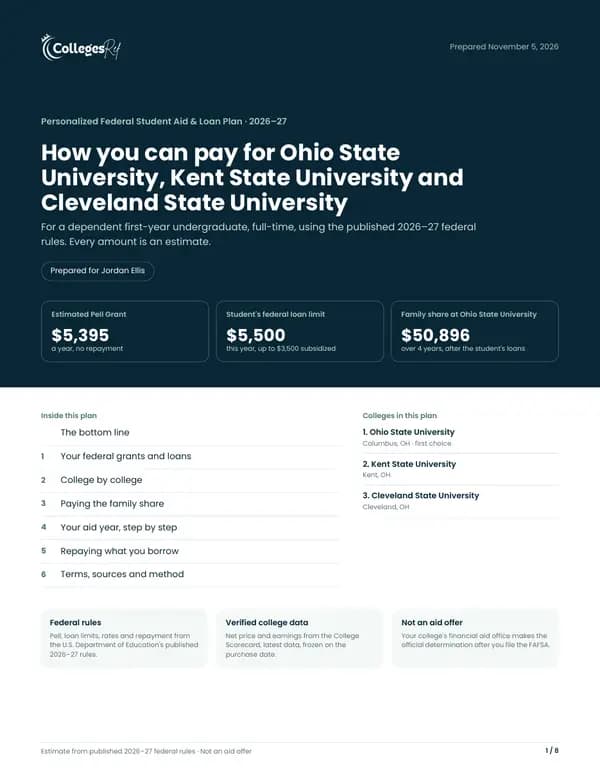
The federal student aid system does not distinguish between online and on-campus enrollment, meaning virtual students have access to the same federal grant programs. For the 2026–27 award year, the maximum Federal Pell Grant is $7,395, according to studentaid.gov. This need-based aid does not require repayment, making it the most valuable form of federal assistance.
To determine eligibility, an applicant must submit the Free Application for Federal Student Aid (FAFSA). The Department of Education calculates a Student Aid Index (SAI) using the financial data from tax returns. If the SAI falls below the minimum threshold set by Congress, the student qualifies for either a maximum or partial Pell Grant.
Applicants can estimate a Pell Grant using online tools before submitting their official FAFSA. However, the actual disbursement depends on enrollment status. For students who enroll part-time, the financial aid office at the university will prorate the award. For example, a student taking six credits in a semester instead of twelve will receive exactly half of their term-based Pell allocation.
Students must monitor their Lifetime Eligibility Used (LEU). The federal government limits Pell Grant funding to a maximum of 12 semesters, or roughly six years of full-time study. For those taking a part-time pace to complete an online degree, calculating cumulative usage carefully is necessary to avoid running out of grant funding before graduation.
Direct Loan Limits for Dependent and Independent Students
When grants do not cover the full cost of tuition, students often turn to federal loans. The U.S. Department of Education sets strict annual and aggregate borrowing caps on Direct Loans. These limits vary significantly based on whether the federal government classifies a student as dependent or independent on the FAFSA.
According to studentaid.gov, dependent undergraduates face the following annual borrowing limits:
- First year: $5,500
- Second year: $6,500
- Third year and beyond: $7,500
Over the course of an undergraduate career, a dependent student can borrow a maximum of $31,000 in total federal loans, of which no more than $23,000 can be subsidized. Over four years, a dependent student can borrow at most $27,000 under the standard annual progression.
Independent students, who are typically age 24 or older, married, or veterans, have access to higher limits to offset the lack of Student Aid Index (SAI):
- First year: $9,500
- Second year: $10,500
- Third year and beyond: $12,500
The aggregate lifetime limit for independent undergraduate borrowers is $57,500.
To act on these limits, request a copy of the financial aid award letter from the school and locate the line item for "Direct Subsidized Loan" and "Direct Unsubsidized Loan." Compare these figures to the remaining tuition balance to identify any funding gaps. If an online program costs more than these federal limits, families must fund the difference through personal savings, private loans, or institutional scholarships. Choosing programs that align with these limits helps avoid high-interest private debt, positioning graduates to benefit from their future salary, which families can research by reviewing the Colleges With the Highest Graduate Earnings: Top 25 Ranked (2026–27).
Red Flags That Signal High-Pressure, Low-Value Online Programs
Comparing Graduation Rates and Post-College Earnings
Evaluating an online program requires looking beyond marketing brochures to analyze federal performance metrics. The CollegesRef 2026–27 edition data shows that the national median graduation rate across all 1,442 published U.S. colleges with at least 2,000 students is 48%. For public colleges, the median graduation rate is 42%, while private nonprofit colleges achieve a median of 70%. Private for-profit institutions match the public median at 42%.
When an online program falls far below these benchmarks, it indicates that most enrolling students do not finish. For example, the CollegesRef 2026–27 edition chart for six of the largest published colleges shows a wide disparity in graduation rates:
- Texas A & M University-College Station: 85%
- Arizona State University Campus Immersion: 67%
- Grand Canyon University: 54%
- Western Governors University: 50%
- Southern New Hampshire University: 42%
- University of Phoenix-Arizona: 21%
Low graduation rates often correlate with poor employment outcomes. The national median earnings 10 years after entry across all analyzed institutions is $52,648. Private nonprofit colleges lead with median earnings of $69,642, followed by public colleges at $49,519, and private for-profit colleges at $45,510.
Before enrolling, request the official College Scorecard data sheet from the admissions office, or search the institution on the CollegesRef colleges by state map to compare its actual graduation rate and median student earnings against these national medians. If a school refuses to provide these figures or redirects you to unverified internal surveys, treat it as an immediate red flag.
Aggressive Recruiting Tactics and Hidden Program Costs
High-pressure online programs often rely on aggressive recruitment tactics to meet enrollment quotas. A primary warning sign is a recruiter who pressures you to sign an enrollment agreement or submit a Free Application for Federal Student Aid (FAFSA) before you receive a formal financial aid award letter.
To protect your budget, ask the financial aid office for a written, itemized cost sheet that lists every mandatory fee per semester. Specifically, ask: "Is there a distance education fee, technology fee, or graduation fee not included in the per-credit tuition rate?"
Compare this itemized sheet against the national median average net price after grants, which is $19,835 across all 1,557 reporting four-year colleges. According to CollegesRef 2026–27 edition data, the median average net price is $10,516 for public colleges, $27,122 for private nonprofits, and $27,612 for private for-profits.
If the school's estimated net cost is significantly higher than these peer averages while its graduation rate is lower, the program offers low financial value. You can research alternative institutions and compare their net prices using our curated College Guides to find programs that align with your budget and career goals. Avoid any institution that uses high-pressure phone calls, offers "limited-time" scholarships that expire in days, or discourages you from comparing costs with other universities.
Three Real-World Scenarios: Calculating the Total Cost of an Online Degree
Scenario 1: A dependent student choosing between public e-tuition and a private nonprofit
This scenario uses hypothetical household figures to show how net price alters the choice between two online programs. A dependent student lives at home and plans to enroll full-time, taking 30 credits per year to finish a 120-credit bachelor's degree in four years.
The student evaluates two options:
- The first option is an online program at an out-of-state public university charging a flat e-tuition rate of $11,000 annually for tuition and fees.
- The second option is a private nonprofit university with a published tuition of $48,600 per year, which matches the median in-state tuition for private nonprofits in the CollegesRef database.
The student files the Free Application for Federal Student Aid (FAFSA). Because the student's family has low income, the student qualifies for the maximum Federal Pell Grant of $7,395, as documented at https://studentaid.gov/understand-aid/types/grants/pell.
At the public university, the Pell Grant applies directly to the $11,000 sticker price.
At the private nonprofit university, the sticker price of $48,600 is far higher. However, CollegesRef data shows the median average net price after grants for private nonprofit colleges is $27,122. The student's financial aid offer includes institutional need-based grants that reduce the actual cost to this median net price. After subtracting the $7,395 Pell Grant, the remaining annual cost is $19,727.
To fund this, the student takes the maximum first-year federal Direct Loan for a dependent undergraduate, which is $5,500 according to https://studentaid.gov/understand-aid/types/loans/subsidized-unsubsidized.
The student chooses the public university. The decision rests on avoiding heavy debt, as the private nonprofit option requires the family to borrow over $56,000 in Parent PLUS loans over four years.
Scenario 2: An independent adult balancing part-time enrollment and work
This scenario uses hypothetical household figures to calculate the real cost of a slower academic pace. An independent adult student works full-time and enrolls part-time, taking six credits per semester for three semesters each year, totaling 18 credits annually. The student chooses a public university charging an in-state rate.
Because the student takes 18 credits per year, completing the 120-credit degree will take 6.6 years.
The student's financial situation includes the following factors:
- The student's income limits their Pell Grant eligibility to $2,000 per year.
- According to federal guidelines at https://studentaid.gov/understand-aid/types/loans/subsidized-unsubsidized, the annual Direct Loan limit for an independent first-year student is $9,500.
Over 6.6 years, the total tuition paid is $33,000. The student chooses this path because the part-time schedule allows them to keep their full-time salary.
Scenario 3: Comparing a public university to a high-cost for-profit program
This scenario uses hypothetical household figures to compare a local public university with an online for-profit institution. A student compares an online bachelor's program at an in-state public university to one at a private for-profit college.
The comparison relies on the following data points:
- The public university has an average net price of $10,516, which is the median for public colleges in the CollegesRef database.
- The private for-profit college has an average net price of $27,612, matching the median for for-profit colleges in the same database.
- The student qualifies for a $3,000 Pell Grant.
- The student borrows the maximum first-year dependent limit of $5,500.
The student chooses the public university. The public option costs $17,096 less per year and aligns with the median public graduation rate of 42%, whereas the for-profit option carries high debt with the same median graduation rate.
You can repeat these calculation steps with your own target colleges using the CollegesRef College Cost Estimator.