Economics
Ranked #23 of 243 for valueEconomics · 230 graduates
- Earnings 4 yrs after
- $124,508
- Ranked-college median: $83,880
- Median debt
- $12,000
- Ranked-college median: $18,500
2,500+ community & trade schoolsNew: 2,500+ community colleges and trade schools added. By stateExplore by state
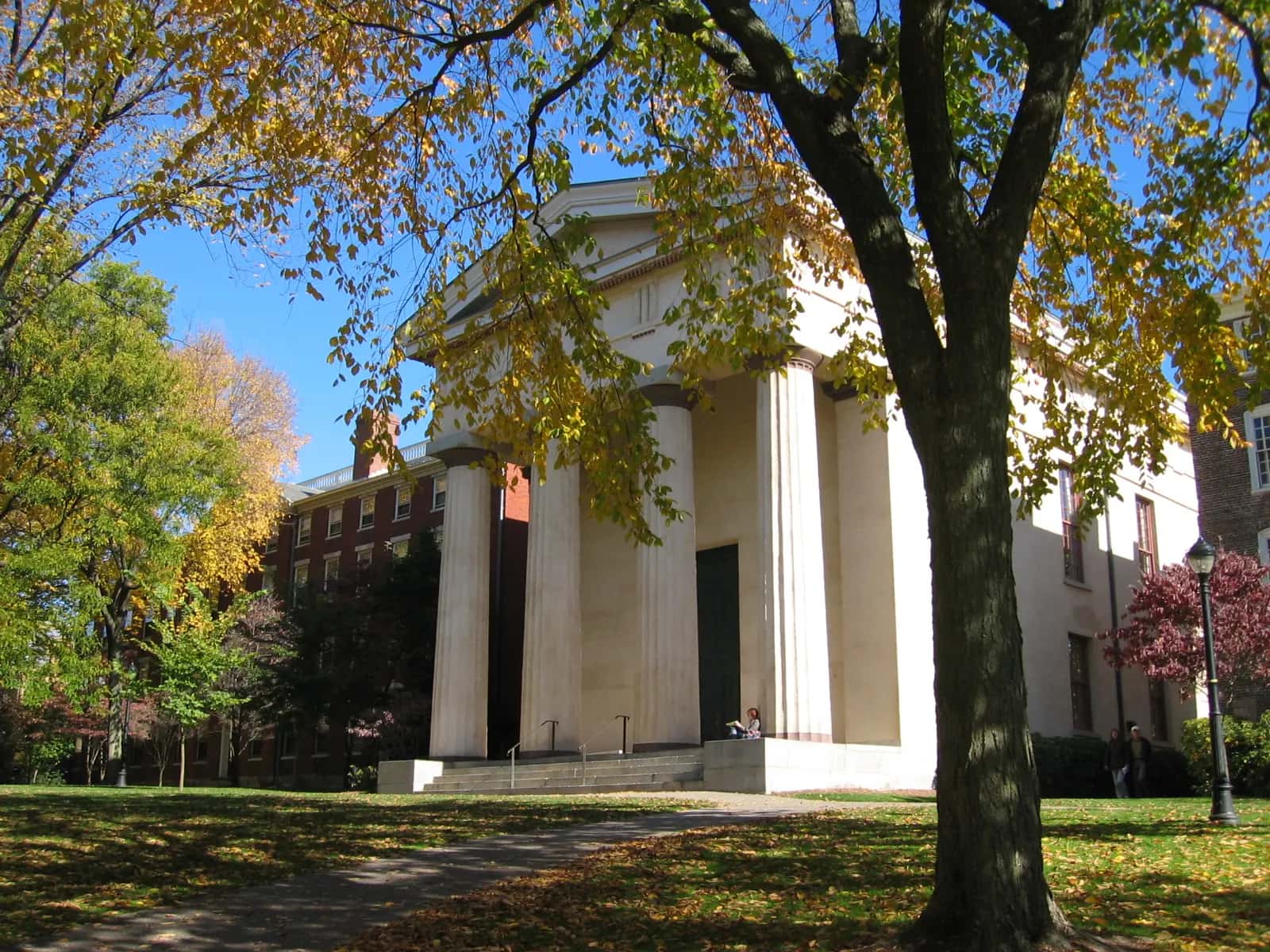
Brown University's acceptance rate is 5.4% (CollegesRef 2026–27 edition). It is a private nonprofit university in Providence, RI, with 7,226 students. The average net price after grants is $26,976 a year. The six-year graduation rate is 95.6%, and median earnings ten years after entry are $99,974.
Data verified Nov 2026 · CollegesRef 2026–27 edition
Photo: Dale182, CC BY-SA 3.0, via Wikimedia Commons
Brown University accepts 5.4% of applicants (latest data). Middle 50% test scores: SAT Reading & Writing 740–780, SAT Math 770–800, ACT 34–35. Admissions details
Larger than 89% of colleges
National median 891
Each finding compares this college's federal figures with other colleges. Your own price and outcome will differ.
Brown University is located in Providence, RI. It admits 5.4% of applicants, lists out-of-state tuition of $74,650 before aid, and reports a 95.6% graduation rate.
- Political climate: 1-30 - Party scene: 30-50 - Athletics culture: 10-30 - Greek life: 60-70 - Housing experience: 70-90 - Student activism: 1-30 - Alternative / creative vibe: 35-70 - Career focus: 20-40 - Scholarly intensity: 60-80
Admit rate
More selective than nearly all colleges
National median 78.1% across 1,958 colleges
Get reminders before the FAFSA opens and before the usual early, Regular Decision and May 1 dates, plus an email when we update Brown University's cost, admission or outcome figures.
We don't list this college's own deadlines; check its admissions site for those.
Average net price
$26,976
What students paid per year on average after grants and scholarships. Your price depends on family income.
Published price vs. what students paid
Students receiving Pell Grants
Free tools
Want it all in one PDF for up to three colleges? See a sample Aid & Loan Plan
Federal data from IPEDS and the U.S. College Scorecard, not student reviews.
Graduation rate
First-time, full-time students finishing within 150% of normal time
First-year retention
Students who return for a second year
Transfer-out rate
First-time, full-time students who transferred to another college
Median earnings
$99,974
Former students who received federal aid
What Brown University graduates earn against what they borrow and what the degree costs after grants.
| Latest official data | This college | Similar colleges |
|---|---|---|
| Median earningsFormer students, 10 years after startingSource: U.S. College Scorecard, latest data | $99,974 | $75,232 |
| Typical federal debtGraduates who borrowed; about $166 a month on a 10-year planSource: U.S. College Scorecard, latest data | $14,567 | $26,949 |
| Years to pay back4 years of average net price ($26,976 a year), paid with 10% of median earningsSource: U.S. College Scorecard, latest data | 10.8 years | 19.7 years |
Similar colleges: the median of 8 private nonprofit four-year colleges in Rhode Island with the same figures reported. Payback is illustrative: it ignores interest, taxes and living costs, and earnings vary by major. Check a loan payment against earnings.
Bachelor's majors where Brown University is ranked in CollegesRef's value rankings. Earnings are medians 4 years after graduating, for graduates who received federal aid; the tick on each bar marks the median of all ranked colleges in that field.
Economics · 230 graduates
Political Science and Government · 63 graduates
Computer Science · 287 graduates
Research and Experimental Psychology · 84 graduates
Engineering, General · 80 graduates
Biology, General · 111 graduates
Total students
7,226
Academic calendar
Semester
Carnegie classification
R1 research university
A Doctoral University (which undergraduates attend) with very high research activity.
A few questions on your grades and budget give a balanced list of colleges, each marked reach, target or likely, with its net price.
Build your free college listWhere the campus is, how far it sits from a major city, and other colleges within reach.
Brown UniversityProvidence, RI, United States
Distances are straight-line miles, not driving distance. Map data © OpenStreetMap contributors, tiles by OpenFreeMap and OpenMapTiles.
Brown University
Providence, RI, United States
Midsize city
Inside an urbanized area and a principal city.
Nearest major cityIn or next to Providence, RI
In the city250 mi
 Rhode Island School of Design RISD0.2 miProvidence · Avg net price $50,513
 Johnson & Wales University-Providence0.6 miProvidence · Avg net price $29,952
 College Unbound1.4 miProvidence · Avg net price $20,804
 Providence College2.1 miProvidence · Avg net price $49,594
 Rhode Island College3.4 miProvidence · Avg net price $10,959Rhode Island School of Design RISD0 mi · Avg net price $50,513Johnson & Wales University-Providence1 mi · Avg net price $29,952
Where campus culture sits on each two-sided scale from 1 to 100, as rated by CollegesRef reviewers.
Campus culture
Ask about admissions, cost or campus life at Brown University. Answers come from CollegesRef data.
Ask CollegesRefWhat sets this college apart, grouped by theme, each with what it means and the data or editorial tag behind it.
Highly selective
Admits a quarter of applicants or fewer.
Admit rate 5.4%
Ivy League
Member of the eight-college Ivy League.
CollegesRef editorial tag
NCAA Division I · The largest programs and athletic scholarships; big-time game days.
Tagged by CollegesRef editors as a big-time athletics school.
Affordable
Lower cost than many comparable colleges for a typical family.
Average net price $26,976 a year after aid
QuestBridge partner
Partners with QuestBridge to fund high-achieving, lower-income students.
CollegesRef editorial tag
Campus life
Liberal-leaning
Campus culture leans politically liberal.
CollegesRef editorial tag
Premium Fit Report$29 once
Your college list and campus fit turned into up to 10 best-fit colleges, with reach, target and likely groups, costs, earnings and an action plan.
Build your free college list See a sample reportAdmit rate, net price and outcomes for Brown University and Duke University, side by side.
Compare with Duke UniversityBrown University admitted 5.4% of applicants in the CollegesRef 2026–27 edition, the most recent release. That is the figure colleges report to the U.S. Department of Education (IPEDS and College Scorecard).
Tuition at Brown University is $74,650 a year before financial aid in the CollegesRef 2026–27 edition. The average net price after grants is $26,976 a year.
The average net price at Brown University, what first-time, full-time students paid after grants and scholarships, was $26,976 a year in the CollegesRef 2026–27 edition. Your own price depends on family income; the college's net price calculator gives a personal estimate.
95.6% of first-time, full-time students at Brown University graduate within six years (150% of normal time), according to the CollegesRef 2026–27 edition.
The closest matches are Duke University, Amherst College, and UC Berkeley, based on admissions, cost, graduation rate, size, and campus profile.
Last checked Nov 3, 2026
Figures come from federal reporting. Text marked “CollegesRef editorial” is our own summary, and similar-college lists come from CollegesRef matching. How we source data
Similar colleges
Bars show profile closeness out of 100: how near each college's graduation rate, size, admit rate, net price, Carnegie class, and control are to Brown University. The order also uses CollegesRef matching tiers, so a later card can score higher.

Duke University
Durham, NC
Graduation rate 96%, close to 96%
Profile closeness95/100

Amherst College
Amherst, MA
Graduation rate 93%, close to 96%
Profile closeness63/100

University of California-Berkeley CAL
Berkeley, CA
Graduation rate 94%, close to 96%
Profile closeness61/100

Columbia University in the City of New York
New York, NY
Graduation rate 95%, close to 96%
Profile closeness85/100

Dartmouth College
Hanover, NH
Graduation rate 95%, close to 96%
Profile closeness94/100

Yale University
New Haven, CT
Graduation rate 96%, close to 96%
Profile closeness83/100
Harvard University
Cambridge, MA
Graduation rate 97%, close to 96%
Profile closeness90/100

University of Pennsylvania UPENN
Philadelphia, PA
Graduation rate 97%, close to 96%
Profile closeness92/100
Save it to your Backpack and compare it with the other schools you are considering.
Add colleges to your Backpack as you research.
Line up cost, admit rate, and outcomes side by side.
Email your Backpack to a parent or counselor.