

Public honors colleges offer the small classes, dedicated dormitories, and thesis advising of an elite private liberal arts college inside a large, state-funded university. High-achieving students who want a tight-knit academic community without paying private tuition benefit most from these programs.
This model matters most for families who do not qualify for need-based financial aid at private institutions but cannot afford to pay the full cost of attendance out of pocket. A common misunderstanding is that an honors college is simply a collection of harder classes. In reality, it is a distinct administrative unit with its own dean, priority registration privileges, and dedicated housing complexes that isolate students from the larger university population.
Key takeaways
- Public honors colleges operate as independent academic units with dedicated housing, priority course registration, and parallel curricula culminating in a senior thesis.
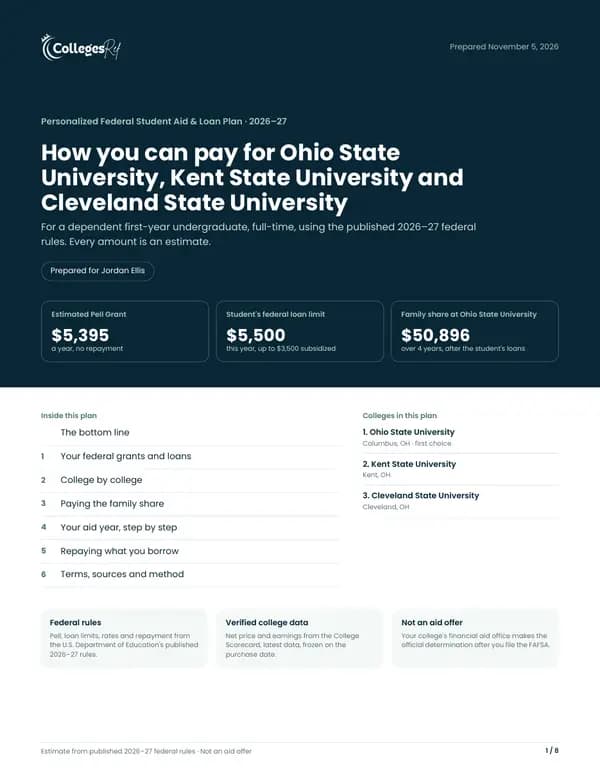
- Enrolling in a public college offers a median average net price of $10,516, compared to $27,122 at private nonprofit institutions.
- To verify housing rules, families should request the Housing License Agreement or the Honors LLC Covenant from the campus housing office.
- Dependent undergraduates can borrow a maximum of $5,500 in their first year, up to $27,000 over four years, according to studentaid.gov.
- The national median share of undergraduates receiving Pell Grants is 34% across all 1,442 published U.S. colleges on CollegesRef.
The Structural Differences Between Honors Colleges and Honors Programs
A public honors college operates as an independent academic unit within a larger state university. It has its own dean, its own budget, and often its own dedicated faculty. In contrast, a standard departmental honors program is a track managed by an individual department, such as history or chemistry, which students typically enter during their junior year. Understanding these structural differences helps families evaluate whether the honors experience justifies the additional fees some public universities charge.
Separate Housing and Dedicated Academic Facilities
An honors college usually features its own physical campus footprint. This infrastructure often includes specialized residence halls, classrooms, study lounges, and computer labs reserved exclusively for honors students. These spaces are designed to create a small liberal arts college atmosphere within a massive state institution.
To verify what a specific university offers, families should take the following steps:
- Request the "Housing License Agreement" or the "Honors Residential Community Handbook" from the campus housing office.
- Look closely at the terms in these documents to see if the university requires honors students to live in the dedicated honors dorm during their freshman year.
- Compare these housing costs across different state institutions by using the colleges by state map to locate and research individual campus housing rate sheets.
Priority Course Registration and Specialized Advising
One of the most significant operational benefits of an honors college is priority course registration. Honors students typically register for classes before the rest of the undergraduate population, often on the very first day of the registration window. This privilege virtually guarantees access to required courses, preventing graduation delays caused by waitlisted classes.
Honors colleges also employ dedicated academic advisors. These advisors maintain smaller student loads than general university advisors, allowing them to spend more time helping students plan dual majors, select study abroad programs, or prepare for graduate school. When researching these benefits, students can consult comprehensive College Guides to see how different state systems structure their advising models. To assess the value of this advising, ask the admissions office for the student-to-advisor ratio specifically within the honors college, and compare it to the general university ratio.
Distinct Graduation Requirements and Thesis Defense
Graduating from an honors college requires completing a distinct curriculum that runs parallel to a student's major requirements. This curriculum typically includes interdisciplinary honors seminars, a minimum cumulative GPA requirement (often between 3.3 and 3.5), and a capstone project.
The capstone project usually culminates in a formal senior thesis defense. A student must select a faculty advisor, write an original research paper or complete a creative project, and defend their work before a committee of three faculty members. This process mirrors graduate-level work. Before accepting an honors college offer, students should calculate the total credit hours required for the honors designation. Subtract the university's general education requirements from the honors curriculum requirements to determine how many extra courses you must fit into your four-year graduation plan.
Comparing the Costs of Public Honors Programs and Private Universities
In-State Tuition Advantages for Honors Students
Enrolling in a public honors college as a resident offers a significant price advantage over private alternatives. According to CollegesRef data in the table below, the median in-state tuition for public colleges is $6,089, compared to a median tuition of $48,600 at private nonprofit institutions. This difference of more than $42,000 per year means a student can often fund their entire four-year public degree for less than the cost of a single year at a private university.
Even when factoring in room, board, and books, the median average net price after grants at public colleges is $10,516, while private nonprofits carry a median net price of $27,122. For a student planning to pursue high-cost graduate programs, such as those detailed in our guide on getting into nursing school: prerequisites, TEAS scores and waitlists, keeping undergraduate debt low is critical. Under federal guidelines from https://studentaid.gov/understand-aid/types/loans/subsidized-unsubsidized, dependent undergraduates can borrow a maximum of $5,500 in Direct Loans during their first year.
Because this federal limit does not cover the net price at most private universities, families must often rely on alternative funding sources. These sources include:
- Private student loans.
- Parent PLUS loans, which are capped at $20,000 annually starting July 1, 2026.
Choosing an in-state public honors option allows many families to cover the remaining balance without exceeding federal student loan limits.
Out-of-State Merit Scholarships and Fee Waivers
For out-of-state applicants, public honors colleges use aggressive merit scholarships to compete directly with elite private universities. The median out-of-state tuition at public institutions is $12,656, which is still substantially lower than the private nonprofit median of $48,600. To attract top-tier students from other states, many public honors programs offer partial or full out-of-state tuition waivers, reducing the tuition rate to the in-state level.
When evaluating these packages, families must check the specific renewal criteria on the financial aid award letter. Honors scholarships often require students to maintain a cumulative GPA of 3.3 to 3.5, which is much higher than the standard 2.0 GPA required for federal student aid. To compare these out-of-state public options against private aid packages, families can use the free college list builder to track net prices side by side.
Additional Fees Charged by Honors Colleges
While public honors colleges are generally affordable, they often charge mandatory fees that do not apply to the general student body. These charges are frequently listed on the student account statement as an "Honors College Fee" or "Honors Program Fee," ranging from $100 to $1,000 per semester.
These fees fund specialized honors advising, smaller seminar classes, and private residential spaces. Before committing, families should email the university's financial aid office to ask if the honors fee is fully covered by the student's merit scholarship or if it must be paid out of pocket. At large public institutions like Arizona State University, which has a 67% graduation rate, these fees are standard, so students must calculate them into their yearly budget.
| Sector | Colleges | Median net price | Median in-state tuition | Median out-of-state tuition | Median graduation rate | Median earnings (10 yrs) |
|---|---|---|---|---|---|---|
| Public | 1,054 | $10,516 | $6,089 | $12,656 | 42% | $49,519 |
| Private nonprofit | 326 | $27,122 | $48,600 | $48,600 | 70% | $69,642 |
| Private for-profit | 62 | $27,612 | $17,370 | $17,370 | 42% | $45,510 |
Source: CollegesRef analysis of IPEDS and College Scorecard data for 1,442 published U.S. colleges with at least 2,000 students (latest data year 2025). Net price is the average paid by first-time, full-time students who receive grant aid.
At a glance
Graduation rate for the colleges in this list
Academic Rigor and Classroom Dynamics in Honors Seminars
Class Size Limits and Discussion-Based Pedagogy
Honors colleges replace massive lecture halls with small, seminar-style classrooms. While a standard introductory chemistry or psychology course at a major public university might seat 300 to 500 students, honors sections of those same courses typically cap enrollment at 15 to 25 students. This smaller environment shifts the instructional model from passive listening to active, discussion-based pedagogy.
To verify these limits before enrolling, an applicant should take the following steps:
- Request a copy of the current semester's course schedule from the honors program coordinator.
- Look specifically at the enrollment caps for honors-designated courses, which are often marked with an "H" suffix on the course code.
- Use these class size metrics to compare colleges side by side and evaluate whether a public honors option truly offers the intimate academic environment of a selective private institution.
Interdisciplinary Core Curricula and Special Seminars
The coursework in an honors college often departs from the standard general education menu. Instead of choosing from a broad list of introductory surveys, honors students frequently complete a structured, interdisciplinary core curriculum. These courses combine perspectives from literature, history, philosophy, and the sciences to address complex global issues.
A student might take a team-taught seminar examining the ethics of artificial intelligence or the history of public health crises. These specialized seminars allow students to fulfill graduation requirements while engaging with more intellectually stimulating material than a standard introductory lecture offers. Families researching these academic pathways can explore High-Paying Degrees With Manageable Coursework: What Graduates Actually Earn to understand how different academic structures impact long-term career outcomes.
Undergraduate Research Opportunities and Faculty Mentorship
Honors colleges provide direct pathways to undergraduate research, often bypassing the competitive application processes that general student populations face. Many honors programs reserve dedicated research fellowships, travel grants, and summer stipends exclusively for their enrollment cohort.
To access these benefits, students typically work directly with a faculty mentor to design and execute an independent research project or a senior thesis. This relationship provides students with academic guidance and crucial letters of recommendation for graduate school or employment.
When attending an admissions open house, families should ask the honors advising office the following questions:
- What is the specific application form used to apply for undergraduate research travel grants?
- What is the annual budget allocation per student for these grants to reveal the actual level of financial support available for independent projects?
Graduation Rates and Career Outcomes for Honors Graduates
How Honors Support Systems Impact Retention
Public honors colleges insulate students from the bureaucratic hurdles that often delay graduation at large state universities. According to CollegesRef data, the median graduation rate across all 1,054 public colleges is 42 percent. Large institutions like Arizona State University report a 67 percent graduation rate, while Texas A & M University-College Station reaches 85 percent.
Colleges in this article

Federal IPEDS and College Scorecard data on CollegesRef. Net price is the average paid after grants by first-time, full-time students who receive aid.
Honors colleges regularly exceed these baseline institutional rates. They achieve this through specific structural supports:
- Honors programs use intrusive advising models to keep students on track.
- Colleges require mandatory first-year seminars to build academic skills.
- Institutions utilize block-scheduled cohort housing to foster community.
These structural supports prevent students from dropping out during the critical transition of the freshman year.
To verify these benefits at a specific campus, follow these steps:
- Contact the honors admissions office directly.
- Ask for the four-year graduation rate specifically for the honors college cohort entry.
- Compare this figure to the six-year rate published on the federal College Navigator.
This distinction reveals how effectively the program keeps students on track to graduate without paying for extra semesters.
Post-Graduation Employment and Median Earnings Data
While honors programs promise enhanced career prospects, actual earnings are heavily influenced by the student's choice of major rather than the honors designation on a diploma. CollegesRef data shows that the median earnings 10 years after entry for graduates of public colleges is $49,519, compared to $69,642 for graduates of private nonprofit colleges. An honors graduate in engineering or computer science from a public university will routinely outearn a humanities honors graduate from the same institution.
When families evaluate financial aid offers, they must weigh these earning realities against potential debt. Under federal rules, dependent undergraduates can borrow a maximum of $5,500 in their first year, up to a total limit of $27,000 over four years, as detailed on studentaid.gov. If a student must exceed these federal limits or rely on parent loans to fund a public honors program, the median post-graduation salary may not comfortably support the debt service.
Families can calculate their projected monthly loan payments using the federal Loan Simulator and compare that number against the median starting salary for their specific major at the target state school.
Graduate and Professional School Placement Success
For students aiming for law, medicine, or doctoral programs, a public honors college offers a distinct tactical advantage. These programs provide structured thesis requirements, dedicated pre-professional advising committees, and direct access to faculty research labs. These resources help undergraduates secure the strong letters of recommendation required for competitive admissions.
When comparing offers, ask the honors program coordinator for a copy of their latest post-graduation outcomes report. Specifically look at the percentage of applicants accepted into medical or law school compared to the overall university average.
This data helps applicants determine if the honors program provides a genuine advantage when learning how to choose between college acceptances before May 1. A high placement rate into top-tier graduate programs confirms that the honors college successfully replicates the elite academic environment of a private university at a public university price point.
The Social Environment and the Honors Community Dilemma
Living-Learning Communities and Peer Cohorts
Most public honors colleges require or strongly encourage incoming freshmen to live in dedicated honors residence halls. These spaces function as living-learning communities where students share both living quarters and seminar classrooms. This structure creates an immediate peer cohort of highly motivated students, reducing the social friction of transitioning to a massive state university.
To evaluate the strength of this community before enrolling, families should request specific documents from the university housing office. These agreements detail the rules, expectations, and housing security of the program.
- Families should request the "Housing License Agreement Addendum" or the specific "Honors LLC Covenant" to review.
- These documents outline the mandatory quiet hours, required community service hours, and the consequences of falling below the honors program GPA threshold.
- These agreements detail whether a student who loses honors status will be forced to pack up and move to a standard dormitory mid-semester.
The Risk of Academic Isolation on a Large Campus
While a close-knit cohort provides immediate academic support, it can also foster a bubble of self-segregation. Students in honors dorms often eat, study, and socialize exclusively with other honors students. This isolation can limit exposure to the broader campus demographic, which is often much more socioeconomically diverse.
According to CollegesRef data, the national median share of undergraduates receiving Pell Grants is 34% across all 1,442 published U.S. colleges. At major public universities, this percentage represents thousands of students from varied backgrounds. Honors colleges, which often attract wealthier applicants who attended well-funded high schools, can insulate their members from this broader peer group.
An applicant can calculate the demographic gap by comparing the percentage of Pell Grant recipients in the overall university to the percentage within the honors college itself. To get this information, follow these steps:
- Email the honors admissions coordinator directly.
- Ask: "What percentage of current students enrolled specifically within the honors college receive federal Pell Grants?"
- Compare the honors college percentage to the university-wide figure to see if the honors environment is significantly less economically diverse.
Balancing Honors Activities with Broad Campus Life
Enrolling in an honors college does not mean a student must forfeit the traditional state university experience. Successful honors students actively seek balance by participating in campus-wide organizations, club sports, or student government. They use the honors college as a quiet sanctuary for sleep and study while treating the larger university as their social and extracurricular playground.
This balance is crucial for long-term career preparation. When researching options on the Best Value Colleges: Graduate Earnings vs. Net Price (2026) index, families will find that post-graduation success relies heavily on soft skills, networking, and leadership outside the classroom.
CollegesRef data shows that the median earnings 10 years after entry for public college graduates is $49,519. To reach or exceed this median, a student needs to build a professional network that extends far beyond a small honors cohort. Joining professional fraternities, volunteering in local community clinics, or working in mainstream campus jobs ensures that an honors student remains grounded and connected to the wider world.
Admissions Requirements and the Application Process
GPA and Standardized Test Score Thresholds
While a typical public university on CollegesRef has a median acceptance rate of 78%, the honors college within that same institution often limits its intake to less than 10% of the incoming class. Public honors colleges use academic thresholds to filter this large volume of applications. Applicants generally must present an unweighted high school GPA of 3.8 or higher to remain competitive.
For institutions that retain standardized testing, middle-50% SAT scores for admitted honors students frequently range from 1380 to 1500, while ACT scores cluster between 30 and 34. Students can check the specific test policies on the institutional Common Application member page. If a university operates under a test-optional policy, the admissions office relies more heavily on the rigor of the high school transcript.
When evaluating test-optional applicants, admissions offices specifically count the following academic credentials completed by the end of the junior year:
- The number of Advanced Placement (AP) courses completed.
- The number of International Baccalaureate (IB) courses completed.
- The number of dual-enrollment courses completed.
Supplemental Essays and Letters of Recommendation
The standard university application is rarely sufficient for honors consideration. Most public honors colleges require a separate application portal or an additional section within the Common Application. This section typically demands two to three supplemental essays focusing on intellectual curiosity.
Applicants must also submit letters of recommendation that specifically address their capacity for independent research. This qualitative evidence helps admissions committees identify students who will thrive in seminar-style classes, which can eventually lead to high-paying careers. Students can compare these outcomes by reviewing the Colleges With the Highest Graduate Earnings: Top 25 Ranked (2026–27).
When requesting these recommendation documents, a student should complete the following steps:
- Ask two core academic teachers to complete the evaluation forms.
- Request that the teachers specifically highlight classroom discussion contributions in their letters.
- Request that the teachers explicitly address analytical writing skills in the evaluation.
Dual-Admission Policies and Mid-Year Entry Options
Many public honors colleges employ a dual-admission system. Under this structure, an applicant must first gain admission to the main university before the honors committee reviews their supplemental file. A rejection from the honors college does not invalidate the general admission offer.
For students who do not meet the initial high school GPA or test score requirements, most public honors colleges offer lateral entry pathways. Current undergraduates can apply for mid-year entry or sophomore-year entry. To apply through this pathway, a student must meet the following criteria:
- Complete at least 15 college credits at the host institution.
- Maintain a cumulative college GPA of 3.5 or higher.
- Submit an internal application form, which is usually available on the honors college website under the "Current Students" tab.
- Submit a recommendation letter from a professor at the university who can vouch for their academic performance.
How Three Different Applicants Evaluated Public Honors College Offers
A First-Generation Student Comparing In-State Options
The household financial figures in this scenario are hypothetical. A student from Ohio with a 3.9 GPA is the first in their family to attend college. The family household income is $42,000.
A student can evaluate in-state options using these three steps:
- First, the student completed the Free Application for Federal Student Aid (FAFSA).
- Second, the student compared two in-state offers.
- Third, the student looked at the borrowing requirements.
The student evaluated these specific financial and academic factors:
- A maximum Federal Pell Grant of $7,395 for the 2026-27 award year, as documented on https://studentaid.gov/understand-aid/types/grants/pell.
- A standard public university admission with an average net price close to the public college national median of $10,516, according to CollegesRef data.
- A public honors college offer with a specialized $3,000 merit scholarship that reduced the net price below the national median.
- Federal guidelines on https://studentaid.gov/understand-aid/types/loans/subsidized-unsubsidized showing a dependent first-year student can borrow a maximum of $5,500 in Direct Loans.
The student chose the public honors college. The combination of the Pell Grant, the honors merit scholarship, and a small subsidized federal loan of $2,500 covered the entire cost of attendance without requiring their parents to take out loans. The honors college also offered priority registration, which guaranteed the student would get the required classes to graduate on time.
An Out-of-State Applicant Weighing Costs and Benefits
The household financial figures in this scenario are hypothetical. A student from Illinois with a 34 ACT score wanted to study engineering. They were admitted to a highly ranked private university and a public honors college in a neighboring state.
An out-of-state applicant can weigh costs using these three steps:
- First, the family analyzed the baseline tuition figures.
- Second, the family compared the net price calculators for both schools.
- Third, the family calculated the total debt needed for four years.
The family compared these specific institutional figures and borrowing limits:
- Median in-state and out-of-state tuition for private nonprofit colleges of $48,600, compared to the median out-of-state tuition for public colleges of $12,656, according to CollegesRef data.
- A private university net price of $28,600 after a $20,000 merit discount, which is near the private nonprofit median average net price of $27,122.
- An out-of-state public honors college tuition rate of $6,089, which is the median in-state tuition for public colleges in the CollegesRef database, made possible by an out-of-state tuition waiver.
- A maximum borrowing limit of $27,000 over four years for a dependent student, according to https://studentaid.gov/understand-aid/types/loans/subsidized-unsubsidized.
- Parent PLUS loans capped at $20,000 per year under federal rules on https://studentaid.gov/understand-aid/types/loans/plus/parent.
The student chose the public honors college. Paying the in-state tuition rate of $6,089 allowed the student to graduate with under $10,000 in total student debt, preserving their parents' retirement savings.
A Pre-Med Student Evaluating Class Sizes and Outcomes
The household financial figures in this scenario are hypothetical. A student from Texas wanted to major in biology to prepare for medical school. They were accepted to a massive state university and its prestigious internal honors college.
A pre-med student can evaluate academic environments using these three steps:
- First, the student researched the graduation rates.
- Second, the student compared the learning environments.
- Third, the student evaluated the cost of the honors fee.
The student compared these specific metrics and program features:
- An overall graduation rate of 85% at Texas A & M University-College Station, which is significantly higher than the national median graduation rate of 48% for all published schools in the CollegesRef data.
- Standard biology track lecture halls with 300 students.
- Seminar-style honors classes capped at 25 students for all foundational science courses.
- An extra honors college fee of $1,000 per semester, which was not covered by standard state grants.
The student chose the public honors college. They decided the small class sizes would allow them to secure the strong letters of recommendation from faculty members necessary for medical school applications, justifying the extra $2,000 annual fee.