
State merit scholarships offer the largest financial incentives in states like Georgia, Florida, and South Carolina, where programs cover up to 100 percent of in-state tuition for qualifying students. These awards significantly lower the cost of attendance at local public universities. By staying in their home state, high-achieving high school graduates can bypass the high tuition rates charged to non-residents.
These programs matter most for middle-income families who do not qualify for federal need-based aid but cannot afford to pay for college out of pocket. A common misunderstanding is that state merit awards automatically apply to any college within state borders. In reality, these funds are usually restricted to public institutions or capped at a much lower rate for private colleges. For example, a student might expect a full ride at a state flagship university but find the award only covers a small fraction of tuition at a private in-state campus.
Key takeaways
- State merit scholarships help students bypass out-of-state tuition, which has a median of $12,675 compared to $6,089 for in-state public colleges.
- Lottery-funded awards require meeting strict academic benchmarks and maintaining a solid completion rate to avoid losing funding at key credit checkpoints.
- Georgia and Florida offer tiered merit programs that require counselors to upload transcripts directly to state portals like GAfutures.
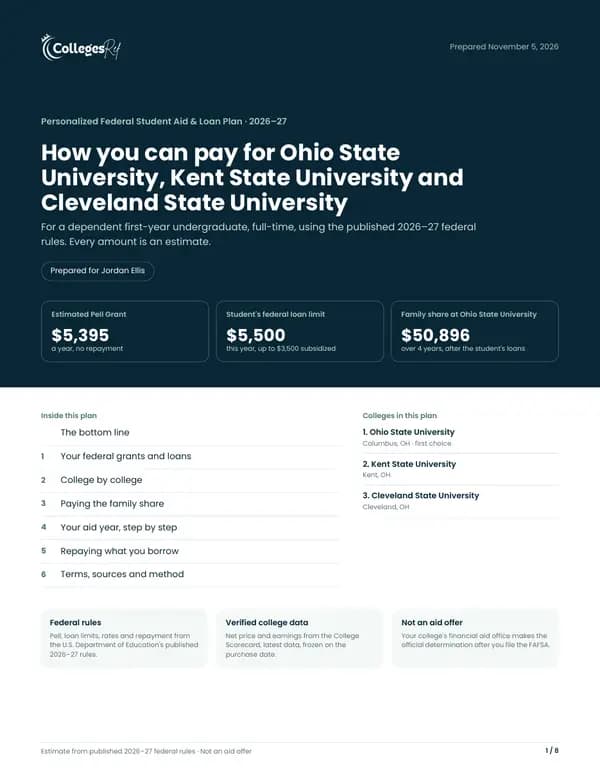
- Federal student loans for dependent undergraduates are capped at $5,500 in the first year and $27,000 over four years.
- Securing these awards requires submitting the FAFSA and monitoring separate state agency deadlines that often fall earlier than institutional dates.
How In-State Scholarship Programs Reduce the Cost of Higher Education
The Financial Gap Between In-State and Out-of-State Tuition
Choosing to attend a public university in your home state immediately lowers the baseline cost of a college degree. According to CollegesRef data shown in the table below, the median in-state tuition at public colleges is $6,089, while the median out-of-state tuition rises to $12,675. This means an out-of-state student pays more than double the tuition rate of a local resident before any financial aid is applied.
For larger research institutions, this pricing gap is often much wider. For example, CollegesRef data shows that out-of-state tuition at The Pennsylvania State University-Main Campus is $42,420, making residency status a primary driver of the total cost of attendance. Families can use the colleges by state map to locate public institutions nearby and compare local tuition rates against out-of-state options.
Colleges in this article

The Pennsylvania State University-Main Campus
University Park, PA
- Admit rate
- 92%
- Net price
- $24,012
- Grad rate
- 72%

Arizona State University Campus Immersion
Tempe, AZ
- Admit rate
- 90%
- Net price
- $14,694
- Grad rate
- 67%
Federal IPEDS and College Scorecard data on CollegesRef. Net price is the average paid after grants by first-time, full-time students who receive aid.
To determine your actual savings, request a residency classification worksheet from the admissions office of your target school. This document outlines the specific state-level rules for establishing domicile, which usually requires living in the state for 12 consecutive months for purposes other than education.
How State-Funded Merit Awards Layer with Federal Aid
State-funded merit scholarships do not operate in a vacuum. Instead, they layer on top of federal programs to further reduce out-of-pocket expenses. When a student completes the Free Application for Federal Student Aid (FAFSA), the federal processor calculates eligibility for need-based assistance. For the 2026-27 award year, the maximum Federal Pell Grant is $7,395, according to studentaid.gov.
When a student qualifies for both the maximum Pell Grant and a state merit award, the institution applies these funds in a specific sequence. Typically, the college first applies federal grants to the student's account balance, followed by state merit aid, and finally any institutional scholarships.
To calculate your potential out-of-pocket costs, locate the "Estimated Financial Assistance" section on your college financial aid portal. Subtract your state merit award and your Pell Grant from the total cost of attendance. If the state award is a "first-dollar" scholarship, it applies directly to tuition regardless of other aid, allowing you to use federal grants for housing and textbooks. If it is a "last-dollar" scholarship, the state only covers the remaining tuition balance after your Pell Grant is applied.
You can find detailed breakdowns of how different states structure these programs in our comprehensive College Guides. Always ask the financial aid office whether your state merit award is classified as first-dollar or last-dollar to avoid unexpected bills.
| Sector | Colleges | Median net price | Median in-state tuition | Median out-of-state tuition | Median graduation rate | Median earnings (10 yrs) |
|---|---|---|---|---|---|---|
| Public | 1,055 | $10,517 | $6,089 | $12,675 | 42% | $49,519 |
| Private nonprofit | 326 | $27,122 | $48,600 | $48,600 | 70% | $69,642 |
| Private for-profit | 62 | $27,612 | $17,370 | $17,370 | 42% | $45,510 |
Source: CollegesRef analysis of IPEDS and College Scorecard data for 1,443 published U.S. colleges with at least 2,000 students (latest data year 2025). Net price is the average paid by first-time, full-time students who receive grant aid.
At a glance
Out-of-state tuition for the colleges in this list
- Grand Canyon University
- $17,900
The Mechanics of a Lottery Scholarship College Award
How State Lotteries Fund Higher Education
State-run lotteries channel a designated percentage of ticket sales directly into higher education trust funds rather than the general state treasury. This dedicated revenue stream allows state legislatures to bypass annual budget battles and offer consistent, multi-year scholarship commitments to local high school graduates. The state treasury or a specific state higher education authority manages these funds, distributing them directly to the financial aid offices of participating public and private institutions.
When a student enrolls, the college applies these lottery dollars directly to the student's account balance. This award appears as a distinct line item on the official financial aid award letter, often labeled with the specific state program name, such as the HOPE Scholarship or the Legislative Lottery Scholarship. Because these funds are tied to state residency, they are designed to offset the costs of local institutions. Families comparing options can use a free college list builder to identify which in-state public universities or local private colleges accept these state-funded awards.
Typical Academic Eligibility and Retention Thresholds
Securing a lottery scholarship requires meeting strict initial academic benchmarks during high school, but keeping the award requires meeting ongoing college performance metrics. Most state programs require a minimum high school GPA, often a cumulative 3.0 on a 4.0 scale, alongside specific standardized test scores. Once in college, students must navigate two primary retention rules: cumulative GPA thresholds and credit-hour completion rates.
The financial aid office evaluates these metrics at specific checkpoints, typically at the end of every spring semester or after a student attempts a set block of 30, 60, or 90 credit hours. To maintain funding, students must usually maintain a cumulative college GPA of 2.75 or 3.0. Additionally, students must meet Satisfactory Academic Progress (SAP) standards by completing a minimum percentage of all attempted credit hours, often 67 percent or higher.
Your Term Credit Hours Completed
---------------------------------  =  Your Completion Rate %
Your Term Credit Hours Attempted
If a student drops a course after the official add/drop period, those hours still count as "attempted" hours. This calculation can inadvertently drop the student below the required completion percentage, triggering an immediate loss of the scholarship.
Before dropping any course, a student should request a "SAP Calculation Worksheet" from their campus financial aid office. Ask the financial aid officer this specific question: "Will withdrawing from this specific course drop my cumulative completion rate below the state merit scholarship retention threshold?"
Understanding these rules is especially critical when choosing between different campus environments. Students weighing Small Colleges vs Large Universities: Class Size, Support, and Fit should consider how academic advising structures at each school help undergraduates monitor their credit hours. A larger university may leave the tracking entirely up to the student, while a smaller campus might offer proactive advising alerts before a student drops a class that could jeopardize their state funding.
Comparing Major State Merit Scholarships Across the Country
The Georgia HOPE and Zell Miller Model
Georgia pioneered the modern state merit scholarship. The program splits into two tiers, both funded by the state lottery and administered by the Georgia Student Finance Commission (GSFC). The HOPE Scholarship covers a portion of tuition at eligible in-state public institutions for students graduating high school with a minimum 3.0 GPA. The Zell Miller Scholarship pays 100% of tuition for students who graduate with a 3.7 GPA and earn a minimum score of 1200 on the SAT or 26 on the ACT.
To secure these funds, high school counselors must upload official transcripts directly to the GSFC portal, GAfutures. Students must monitor their "My HOPE Profile" on the portal to verify that their calculated GPA matches their school records. If a student plans to pursue a Double Major or Major and Minor: What Each Adds to Your Degree, they must confirm with the financial aid office that the state will fund the extra credit hours, as both scholarships cap lifetime eligibility at 127 attempted semester hours.
Florida Bright Futures Requirements and Payouts
Florida offers a similar tiered system funded by the Florida Lottery. The Florida Academic Scholars (FAS) award covers 100% of tuition and applicable fees at public institutions. The Florida Medallion Scholars (FMS) award covers a significant portion of tuition and fees, which is set at a lower tier than the full-tuition FAS payout. High school seniors must complete the Florida Financial Aid Application (FFAA) before August 31 of their graduation year to qualify.
The academic thresholds are rigid. FAS requires a 3.5 weighted GPA, a 1340 SAT or 29 ACT, and 100 documented volunteer service or paid work hours. FMS requires a 3.0 GPA, a 1210 SAT or 25 ACT, and 75 service or work hours. Students must submit their service hours log directly to their high school guidance counselor for official entry into the state database before graduation.
Other Notable State Programs with Strict Residency Rules
Many states restrict their largest awards to students who remain in-state. For example, the Taylor Opportunity Program for Students (TOPS) in Louisiana offers four award levels that pay tuition at state public colleges, requiring a minimum 2.5 core GPA and a 20 ACT score. In New Mexico, the Legislative Lottery Scholarship covers up to 100% of tuition for students who enroll full-time at a public college immediately after high school graduation.
Families can compare colleges side by side to see how these state awards change the net price of local public universities versus out-of-state options. CollegesRef data shows that the median in-state tuition at public colleges is $6,089, while the median out-of-state tuition is $12,675. When a student qualifies for a full-tuition state merit award, the tuition cost drops to zero, widening the financial gap between staying home and leaving the state. To calculate the exact value of a state award, ask the financial aid office of the target college for their "Cost of Attendance minus State Merit" figure, which reveals the remaining out-of-pocket balance for housing and food.
Federal Loan Limits and the True Cost of Leaving Your Home State
Direct Loan Caps for Dependent and Independent Undergraduates
When an in-state merit scholarship is off the table, students often turn to federal student loans to bridge the funding gap. However, the U.S. Department of Education strictly limits how much an undergraduate can borrow directly. According to federal guidelines on studentaid.gov, a dependent undergraduate can borrow a maximum of $5,500 in their first year. This limit rises to $6,500 in the second year and caps at $7,500 for the third year and beyond. Over a standard four-year degree, a dependent student can borrow a maximum of $27,000 in federal Direct Loans.
Independent undergraduates have higher limits, starting at $9,500 in the first year and capping at $12,500 annually in the third year and beyond, with an aggregate limit of $57,500. Even with these higher limits, federal loans rarely cover the full cost of attending an out-of-state public university. CollegesRef data shows that the median out-of-state tuition at public colleges is $12,675. This figure does not include housing, food, or textbooks.
A student can calculate their potential funding gap by subtracting their federal student loan limit from the "Total Cost of Attendance" line on their financial aid award letter. If the gap is wider than the federal loan limits, families must find alternative funding, which often leads to high-interest private student loans.
The Impact of Parent PLUS Borrowing Limits on Out-of-State Choices
To cover the remaining balance of out-of-state costs, many families look to federal Parent PLUS loans. New federal regulations place strict caps on this borrowing option. For loans first disbursed on or after July 1, 2026, Parent PLUS borrowing is capped at $20,000 per year and $65,000 in total per dependent student, according to studentaid.gov.
These caps change the financial equation for families looking at out-of-state public universities. For example, CollegesRef data shows that out-of-state tuition at The Pennsylvania State University-Main Campus is $42,420, while Arizona State University Campus Immersion charges $35,167. A first-year dependent student attending Penn State can only borrow $5,500 in their own name. Even if their parents borrow the maximum allowed Parent PLUS limit of $20,000, the combined federal borrowing of $25,500 still leaves a tuition shortfall of more than $16,000, before adding room and board.
Before signing a financial aid package, parents should request a "Financial Aid Offer Review" from the university's financial aid office to ask if any institutional grants can fill the gap. Families should also research regional tuition discount programs, such as the Academic Common Market: Southern Out-of-State Tuition Waivers, which allow students to pay in-state tuition rates for specific majors. Without these waivers or a state merit scholarship, families are forced to rely on private loans, which lack the federal repayment protections and income-driven repayment plans of the Direct Loan program.
Academic Progress Requirements That Put State Aid at Risk
Understanding Satisfactory Academic Progress (SAP) Standards
Every college participating in federal student aid programs must enforce a Satisfactory Academic Progress (SAP) policy. State agencies almost always tie their merit scholarship renewals to these same federal benchmarks, or they establish even stricter guidelines. To maintain eligibility, a student must meet three distinct measurements monitored by the campus financial aid office.
First, the qualitative measure requires a student to maintain a specific cumulative grade point average. Second, the quantitative measure, often called the pace or completion rate, requires a student to successfully complete a minimum percentage of all attempted credit hours. This completion rate is calculated by dividing cumulative earned credit hours by cumulative attempted credit hours. For example, a student who registers for 15 credits in the fall semester but drops a course after the add/drop deadline has attempted more credits than they earned, which lowers their completion percentage. Third, students must complete their degree program within a maximum timeframe, which federal rules cap at a set percentage of the published program length.
Families can request a copy of the specific SAP policy document directly from their institution's financial aid office. This document outlines how the registrar treats remedial courses, repeated classes, and withdrawals. When evaluating the long-term return on tuition, families can compare institutional outcomes using the Best Value Colleges: Graduate Earnings vs. Net Price (2026) guide to see how graduation rates align with average student debt.
What Happens to Your State Funding If Your GPA Drops
Losing a state merit scholarship can happen quickly, often after a single difficult semester. Unlike federal Pell Grants, which fluctuate based on financial need, state merit awards usually have rigid GPA renewal thresholds that do not offer a soft landing. If a state program requires a cumulative 3.0 GPA at the end of each spring semester, a student finishing the year with a 2.99 GPA will lose the entire award for the upcoming autumn term.
When a student falls below the required threshold, the financial aid office sends an official SAP suspension notice, typically via the student's campus email portal. At this point, the student must pay the full in-state tuition rate out of pocket or secure alternative funding. CollegesRef data shows that the median in-state tuition at public colleges is $6,089, a sum that can suddenly double or triple a family's expected yearly expenses if state aid vanishes.
To appeal the loss of state aid, a student must file a formal SAP Appeal Form with the financial aid office. This process requires documenting mitigating circumstances, such as a severe personal illness, the death of an immediate family member, or a natural disaster. The student must write a detailed personal statement explaining why they failed to meet the academic standards and what specific changes they have made to ensure future academic success. Additionally, the student must submit third-party documentation, such as medical records or a letter from a licensed counselor, alongside an academic recovery plan signed by their academic advisor.
How to Apply for and Secure Your State Merit Award
Completing the FAFSA and State-Specific Financial Aid Forms
Securing a state merit scholarship starts with the Free Application for Federal Student Aid (FAFSA). Many families assume the FAFSA only dictates federal grants or loans, but state agencies use this federal data to verify residency, dependency status, and basic academic eligibility. When completing the FAFSA, an applicant must list at least one eligible in-state institution in the "Selected Colleges" section to trigger the release of their data to the state higher education agency.
Beyond the FAFSA, most states require a separate application through their own dedicated portal. For example, students in Georgia must complete the GSFAPPS application through the Georgia Student Finance Commission portal to apply for the HOPE or Zell Miller scholarship. In other states, the state agency pulls GPA and standardized test data directly from high school transcripts. A student should ask their high school guidance counselor for a copy of their official state-calculated GPA, which often differs from the cumulative GPA printed on a standard report card. This official calculation determines whether a student meets the exact threshold for funding.
If a student plans to attend one of the Colleges With the Highest Graduate Earnings: Top 25 Ranked (2026–27), they must verify that the private or public institution participates in the state's merit program. Some states restrict merit awards exclusively to public universities, while others offer a prorated voucher for private, non-profit campuses.
Critical Deadlines for State Higher Education Agencies
State merit programs operate under rigid timelines that are often much earlier than federal or institutional deadlines. While the federal FAFSA processing cycle runs through the end of the academic year, state agencies frequently close their application windows in the early spring or summer prior to fall enrollment. Missing a state deadline by a single day typically results in a complete forfeiture of funding for that academic year, with no option for retroactive appeals.
Families must monitor three distinct deadlines: the institutional priority deadline, the state agency application deadline, and the high school transcript submission deadline. To calculate your personal timeline, look up the "State Aid Deadline" on your state’s higher education website and subtract 14 business days. This is your target date to request that your high school registrar upload your final, eighth-semester transcript to the state portal.
For students utilizing these awards, CollegesRef data shows that public colleges have a median in-state tuition of $6,089, compared to a median out-of-state tuition of $12,675. Securing your state merit award on time can reduce that in-state cost even further, sometimes to zero. Keep a written log of the confirmation number generated when you submit your state-specific application, and check your college financial aid portal by July to confirm that the state merit award appears as a pending credit on your tuition bill.
In-State vs. Out-of-State Cost Scenarios with State Merit Aid
Scenario 1: A high-achieving student choosing between a local public university and an out-of-state flagship
All household figures in this scenario are hypothetical. An applicant from Florida has a 3.9 high school GPA and a 1340 SAT score, qualifying for the Florida Bright Futures Academic Scholars award, which covers 100% of tuition and applicable fees at a public university in Florida. The student is deciding between staying in-state at a local public university or attending Arizona State University Campus Immersion as an out-of-state student.
First, the family looks at the baseline tuition costs. According to CollegesRef data, the median in-state tuition for public colleges is $6,089, while the out-of-state tuition for Arizona State University Campus Immersion is $35,167.
Second, the family calculates the net tuition cost after applying the state merit award. At the local Florida public university, the Bright Futures award reduces the tuition balance to $0.
Third, the student evaluates federal student loan limits to see how much of the remaining gap can be covered without private loans. According to studentaid.gov, a dependent first-year undergraduate can borrow a maximum of $5,500 in Direct Loans.
The family decides to choose the in-state university. Staying in Florida allows the student to graduate with zero tuition debt, whereas attending the out-of-state flagship leaves a first-year tuition gap of $14,667 even after using the maximum federal student loan.
Scenario 2: A Pell-eligible student evaluating a state grant against an out-of-state private college
All household figures in this scenario are hypothetical. A student from New Jersey has an expected family contribution that qualifies for the maximum Federal Pell Grant. The student is comparing Rutgers University, an in-state public option where they qualify for the New Jersey Tuition Aid Grant (TAG), to a private nonprofit university out-of-state.
First, the student gathers the baseline costs. CollegesRef data shows that the median in-state tuition for public colleges is $6,089, while the median out-of-state tuition for private nonprofit colleges is $48,600.
Second, the student applies federal and state grants to the in-state option. According to studentaid.gov, the maximum Federal Pell Grant is $7,395. This federal grant completely covers the median in-state tuition of $6,089, leaving a surplus of $1,306 for fees. The addition of a $3,000 New Jersey TAG award further reduces the cost of housing and food.
Third, the student calculates the cost of the out-of-state private college. The private college offers a $25,000 institutional grant.
The student decides to attend the in-state public university. The combination of the Pell Grant and the state merit award covers all tuition and contributes to living expenses, preventing the student from needing to borrow.
Scenario 3: A student comparing an in-state lottery scholarship with a regional out-of-state public option
All household figures in this scenario are hypothetical. A student from Tennessee qualifies for the HOPE Scholarship, which provides $4,500 per year for the first two years at an in-state public university. The student is comparing this to attending The Pennsylvania State University-Main Campus as an out-of-state student.
First, the student compares the starting tuition rates. CollegesRef data shows the median in-state tuition for public colleges is $6,089, while the out-of-state tuition for Penn State is $42,420.
Second, the student subtracts the state aid from the in-state tuition.
Third, the student calculates the out-of-state funding gap. Penn State offers no regional tuition waivers to this applicant, leaving the tuition at $42,420. Under studentaid.gov rules, the student can borrow $5,500 in Direct Loans, and their parents can borrow up to $20,000 in Parent PLUS loans.
The student decides to enroll in-state.