

Paying out-of-state tuition at a public university is rarely worth the extra cost when compared to staying in-state. For most students, the steep price premium does not translate into proportionally higher post-graduation earnings. Choosing a local public campus usually delivers a far stronger return on your investment.
This financial calculation matters most for middle-income families who do not qualify for need-based aid but cannot afford to pay cash for college. A common misunderstanding is that out-of-state public universities will discount their sticker price with institutional grants to match in-state rates. In reality, state schools reserve their largest financial aid packages for resident students. Nonresidents usually pay the full out-of-state rate, forcing families to cover a massive funding gap through private loans or federal Parent PLUS loans.
Key takeaways
- CollegesRef data shows median out-of-state tuition at public colleges is $12,715, which is more than double the median in-state tuition of $6,034.
- Dependent undergraduate students face strict federal Direct Loan limits, capping their total borrowing at $27,000 over four years of college.
- Private nonprofit colleges have a median graduation rate of 70%, compared to a lower median graduation rate of 38% at public universities.
- Starting July 1, 2026, federal Parent PLUS loans are capped at $20,000 per year and $65,000 in total per dependent student.
- CollegesRef data shows median earnings 10 years after entry are $69,656 for private nonprofit graduates and $49,461 for public college graduates.
The Price Gap Between Resident and Nonresident Tuition
Why Public Universities Charge Two Different Rates
State taxpayers fund public universities to provide affordable higher education for local residents. Because out-of-state families have not paid into that state's tax base, public institutions charge them a premium to offset the lack of local tax support. This surcharge helps cover the actual cost of instruction and campus operations.
To verify residency requirements, a university admissions office will review your residency questionnaire, which is typically submitted alongside the main application. You can request a copy of the institution's residency classification guidelines directly from the office of the registrar. Families should look closely at the physical presence and financial independence rules, as simply living in a state to attend college does not qualify a student for the lower rate.
Analyzing the Average Cost Premium for Out-of-State Students
The financial difference between staying in-state and crossing state lines is substantial. According to CollegesRef IPEDS data shown in the table below, the median in-state tuition at public colleges is $6,034, while the median out-of-state tuition rises to $12,715. This means nonresident students face a median tuition premium of $6,681 per year before accounting for housing, food, or travel.
For a student looking at large public flagship institutions, the gap can be even wider. For example, Texas A & M University-College Station has a high graduation rate of 85% according to CollegesRef data, but its out-of-state tuition surcharge adds tens of thousands of dollars to the annual cost of attendance for nonresidents. Families can calculate their own potential premium by subtracting the resident tuition line from the nonresident tuition line on a university's published bursar website.
Colleges in this article

Texas A & M University-College Station
College Station, TX
- Admit rate
- 57%
- Net price
- $21,527
- Grad rate
- 85%

The Pennsylvania State University-Main Campus
University Park, PA
- Admit rate
- 92%
- Net price
- $24,012
- Grad rate
- 72%

Grand Canyon University
Phoenix, AZ
- Admit rate
- 79%
- Net price
- $21,509
- Grad rate
- 54%
Federal IPEDS and College Scorecard data on CollegesRef. Net price is the average paid after grants by first-time, full-time students who receive aid.
How Net Price Differs From Published Sticker Prices
Sticker price is rarely what a family actually pays. The net price represents the final cost of attendance after subtracting all federal, state, and institutional grant aid. For public colleges, the median average net price is $10,437, which is higher than the median in-state tuition but still significantly lower than the average private school cost.
To find your expected cost, do not rely on the published tuition table. Instead, search for the net price calculator on the financial aid website of each target university. You will need to enter figures from your family's most recent federal tax returns and W-2 forms. The calculator will estimate your institutional grant eligibility, which can sometimes narrow the gap between the in-state and out-of-state cost. For more detailed strategies on evaluating these costs, families can consult the CollegesRef college guides to understand how different financial aid packages are structured.
| Sector | Colleges | Median net price | Median in-state tuition | Median out-of-state tuition | Median graduation rate | Median earnings (10 yrs) |
|---|---|---|---|---|---|---|
| Public | 1,041 | $10,437 | $6,034 | $12,715 | 38% | $49,461 |
| Private nonprofit | 323 | $27,167 | $48,723 | $48,702 | 70% | $69,656 |
| Private for-profit | 44 | $30,181 | $18,367 | $18,367 | 41% | $47,524 |
Source: CollegesRef analysis of IPEDS and College Scorecard data for 1,408 published U.S. colleges with at least 2,000 students (latest data year 2025). Net price is the average paid by first-time, full-time students who receive grant aid.
At a glance
Graduation rate for the colleges in this list
Comparing Public University Costs to Private Institutions
When Out-of-State Public Fees Exceed Private Tuition
Families often assume public universities always cost less than private ones. CollegesRef data shows a median in-state tuition of $6,034 at public colleges, which rises to a median out-of-state tuition of $12,715. For private nonprofit colleges, the median tuition is $48,723.
While the published sticker price of a private university is higher, the net price tells a different story. Private institutions often use institutional grants to discount their rates. According to CollegesRef data, the median average net price after grants at private nonprofit colleges is $27,167, compared to a median average net price of $10,437 at public colleges.
To find your actual cost, do not rely on sticker prices. Request the Financial Aid Award Letter from each campus and locate the "Net Price" line, which subtracts institutional grants and scholarships from the total cost of attendance. If a prestigious out-of-state public university offers you no merit aid, its net price can easily exceed that of a private college that offers a generous institutional discount.
Graduation Rates and Time-to-Degree Cost Implications
A lower annual price can become expensive if a student takes five or six years to graduate. Extra semesters mean paying more tuition, buying more meal plans, and delaying entry into the workforce.
CollegesRef data shows a stark difference in graduation rates across sectors. The median graduation rate for public colleges is 38%. Private nonprofit colleges have a median graduation rate of 70%, while private for-profit colleges sit at 41%.
These differences are visible at major institutions. For example, The Pennsylvania State University-Main Campus has a graduation rate of 72%, which is significantly higher than the public college median. In contrast, CollegesRef data shows a 54% graduation rate at Grand Canyon University and a 42% graduation rate at Southern New Hampshire University.
Before committing to an out-of-state public school, ask the admissions office for their four-year graduation rate specifically for out-of-state students. If the rate is low, calculate the cost of a fifth year by multiplying the out-of-state tuition and living expenses by 1.25.
Post-Graduation Earnings and Return on Investment
Evaluating the return on your investment requires looking at what graduates earn ten years after they start college. Higher debt for an out-of-state degree is only rational if the credential yields a proportional earnings premium.
According to CollegesRef data, the median earnings 10 years after entry for students at private nonprofit colleges is $69,656. This is higher than the median earnings of $49,461 for public college students and $47,524 for those who attended private for-profit institutions.
Compare these figures to the median earnings of $52,768 across all 1,408 published U.S. colleges on CollegesRef with at least 2,000 students. If an out-of-state public university program does not lead to a high-paying field, paying a premium over your local in-state option is difficult to justify. Use the federal College Scorecard search tool to look up the specific median earnings by major for each campus on your list.
Federal Aid Limits and the Out-of-State Funding Gap
Pell Grant Limits for Lower-Income Applicants
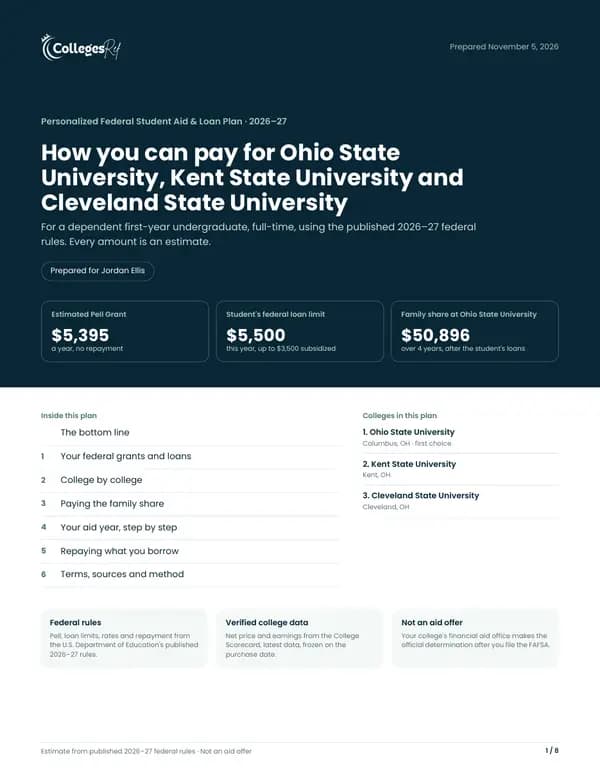
The Free Application for Federal Student Aid (FAFSA) determines eligibility for federal grants, but these funds rarely cover the tuition premium charged to nonresidents. According to studentaid.gov, the maximum Federal Pell Grant for the 2026-27 award year is $7,395 (https://studentaid.gov/understand-aid/types/grants/pell). This maximum voucher is reserved for students with the lowest Student Aid Index (SAI) numbers on their FAFSA Submission Summary.
CollegesRef data shows that the median out-of-state tuition at public colleges is $12,715, which is more than double the median in-state tuition of $6,034. A Pell Grant recipient attending an out-of-state public institution will find that the maximum grant leaves a significant portion of the tuition unpaid. This gap does not even account for mandatory campus fees, housing, or food. Families must calculate their personal funding gap by subtracting their Pell Grant allocation from the "Total Cost of Attendance" line on the financial aid award letter.
Direct Loan Borrowing Caps for Dependent and Independent Students
When federal grants fall short, students often turn to federal Direct Loans, but strict annual limits prevent applicants from borrowing the full tuition differential. Undergraduates who rely on their parents for financial support face tight borrowing caps. According to studentaid.gov, dependent undergraduates can borrow a maximum of $5,500 in their first year, $6,500 in their second year, and $7,500 in their third year and beyond (https://studentaid.gov/understand-aid/types/loans/subsidized-unsubsidized). Over four years, a dependent student can borrow at most $27,000.
Independent students, who do not have access to parental financial support, have slightly higher limits. These students can borrow up to $9,500 in their first year, $10,500 in the second year, and $12,500 in the third year and beyond, up to an aggregate limit of $57,500. If a student chooses a high-cost nonresident option like Arizona State University Campus Immersion, these federal loan limits will not cover the annual out-of-state cost premium. To find out how much of your loan package is subsidized, check the "Subsidized Direct Loan" line on your financial aid offer, as this portion does not accrue interest while you are enrolled.
New Parent PLUS and Graduate Loan Restrictions
To fill the remaining funding gap, families historically turned to federal parent loans, but recent regulatory changes have capped these options. For loans first disbursed on or after July 1, 2026, Parent PLUS borrowing is capped at $20,000 per year and $65,000 in total per dependent student (https://studentaid.gov/understand-aid/types/loans/plus/parent). This cap means parents can no longer borrow unlimited amounts to cover expensive out-of-state tuition bills.
Furthermore, graduate students face new borrowing structures. For new borrowers from July 1, 2026, Grad PLUS loans end entirely. Graduate students may borrow up to $20,500 a year with a $100,000 aggregate limit, and professional students up to $50,000 a year with a $200,000 aggregate limit in Direct Unsubsidized Loans (https://studentaid.gov/understand-aid/types/loans/subsidized-unsubsidized). Families must ask the university financial aid office for a "Cost of Attendance Worksheet" to calculate whether their total federal aid, including the capped Parent PLUS loans, will leave an unpaid balance that requires expensive private student loans.
How to Qualify for In-State Tuition Rates
Establishing Legal Domicile and Residency Requirements
State universities use strict legal standards to determine who qualifies for resident tuition. Simply living in a state to attend classes does not make a student a resident for tuition purposes. An applicant must establish a permanent legal domicile, which means proving the state is their primary, permanent home.
Most public institutions require a student or their parents to maintain continuous physical presence in the state for at least 12 consecutive months before the first day of classes. To verify this, university residency classification officers look for concrete ties established at the start of that 12-month window. A student must show intent to remain in the state permanently by taking specific, documented actions. These actions include registering to vote, obtaining a state driver's license, and registering any vehicles with the state department of motor vehicles.
Families can calculate their residency timeline by looking at the issue date on their new driver's license. If that date is less than 365 days before the university's official residency determination date, the school will classify the student as a nonresident.
The Role of Parent Tax Returns and Physical Presence
For dependent students, residency status is almost always tied to the domicile of their parents. If a parent claims the student as a dependent on their federal income tax return, the student's residency matches the parent's state of residence.
When applying for in-state status, the residency office will ask for a copy of the parent’s state and federal tax returns from the most recent tax year. They will check the address listed on Form 1040 and verify that state income taxes were paid to the state where the university is located.
If parents are divorced and live in different states, the rules vary by institution. Some universities, such as Texas A & M University-College Station, allow a student to qualify for in-state tuition if at least one parent has established a legal domicile in the state for the required 12-month period. Families in this situation should contact the university's admissions or registrar office directly and ask for the specific "Core Residency Questions" form to see how parental divorce affects their classification.
Common Pitfalls That Disqualify Nonresident Applicants
Many families assume that buying a home in the university's state or using a relative's address is enough to secure in-state rates. Residency offices easily spot these tactics and will deny the application. Owning property in a state does not prove physical presence or legal domicile if the family's primary income is earned elsewhere.
Another common pitfall is relying on financial support from out-of-state parents while trying to establish independent student status. To be classified as an independent student for tuition purposes, an applicant must typically prove they are entirely self-sufficient. This requires showing sufficient earned income on their own W-2 forms to cover all living expenses and tuition, without any parental co-signers or financial gifts.
Regional Tuition Reciprocity Agreements and Exemptions
Multi-State Compacts and Discount Programs
State borders do not always dictate tuition costs. Regional interstate compacts allow students to attend public universities in neighboring states at a reduced rate. The Western Undergraduate Exchange (WUE), coordinated by the Western Interstate Commission for Higher Education, caps nonresident tuition at a set percentage of the enrolling institution's resident rate. Similar agreements exist through the Midwest Student Exchange Program and the New England Board of Higher Education.
These discounts are not applied automatically. Applicants must select the reciprocity program on the Common Application or submit a specific residency petition directly to the university admissions office. To calculate the potential savings, families must check the specific discount percentage cap set by the compact for that campus, as the final rate is tied directly to the institution's resident tuition.
Academic Common Market and Specialized Major Waivers
The Southern Regional Education Board operates the Academic Common Market. This program allows students to pay in-state tuition rates at out-of-state public universities if their home state does not offer their chosen degree program. For example, a student wanting to study aerospace engineering or marine biology can access these specialized programs in a participating southern state without paying nonresident premiums.
To secure this waiver, an applicant must first gain admission to the out-of-state university in the specific, approved major. After receiving the admission letter, the student must submit a certification application to their home state's Academic Common Market coordinator. This application requires proof of residency, such as a parent's state tax return, and official documentation of the student's declared major. If the student changes their major to a common program after enrolling, the university will immediately strip the waiver and bill the student for full nonresident tuition on the next bursar statement.
Institutional Merit Scholarships for Nonresidents
Many public universities use merit scholarships to recruit high-achieving students from other states. These awards often function as partial or full tuition waivers, reducing the nonresident cost to match or closely approximate the in-state rate. At Purdue University-Main Campus, out-of-state applicants are automatically considered for merit scholarships like the Trustees Scholarship or the Presidential Scholarship if they submit their application by the early action deadline.
Families must ask the financial aid office whether a merit scholarship can be combined with other institutional grants. Some universities use a "stacking" policy, while others reduce institutional aid dollar-for-dollar if an outside scholarship is secured. When reviewing the financial aid award letter, look closely at the line item for nonresident fees. If a merit scholarship is listed, verify whether the award requires a minimum cumulative GPA, such as a 3.0 or 3.2, to remain active for all four years of study.
Evaluating the Long-Term Financial Impact of College Debt
Calculating the Monthly Payment on Nonresident Student Loans
Borrowing to cover the nonresident premium changes a student's financial trajectory long after graduation. According to CollegesRef data, the median out-of-state tuition at public colleges is $12,715, compared to a median in-state tuition of $6,034. This annual gap of $6,681 translates to over $26,000 in extra tuition alone over four years, before accounting for interest.
To understand the monthly impact, families must calculate potential payments using the federal loan limits. For a dependent undergraduate, studentaid.gov states that the maximum aggregate Direct Loan limit is $31,000, with a maximum of $27,000 borrowable over four years. If a student borrows the full $27,000, the standard 10-year repayment plan requires a monthly payment that families can estimate using the loan simulator tool on the federal student aid website.
When federal loans do not cover the out-of-state gap, families often turn to private loans or Parent PLUS loans. Under federal rules on https://studentaid.gov/understand-aid/types/loans/plus/parent, Parent PLUS loans first disbursed on or after July 1, 2026, are capped at $20,000 per year and $65,000 in total. Borrowing up to this maximum $65,000 limit adds a significant monthly payment to the family's obligations. Families should request a projected loan amortization schedule from the financial aid office before signing the Master Promissory Note.
How Excess Debt Affects Early-Career Decisions
High monthly loan payments limit a graduate's flexibility during their first decade in the workforce. CollegesRef data shows that the median earnings for public college graduates 10 years after entry stand at $49,461. A student earning this median salary brings home a modest monthly income after federal, state, and local taxes.
If a graduate faces a combined monthly student loan payment of several hundred dollars, they must allocate a large percentage of their take-home pay to debt service. This heavy debt burden forces graduates to delay major milestones such as buying a home, saving for retirement, or relocating for career advancement. It also prevents them from taking lower-paying, high-growth entry positions or working at public service non-profits.
Comparing Local Job Markets and Regional Alumni Networks
An out-of-state university often promises a national brand, but its career services office and alumni network are usually concentrated in its home region. A student attending Indiana University-Bloomington Main Campus as a nonresident will pay premium tuition, but the on-campus recruiting events and local internships will lean heavily toward Midwest employers.
Before committing to nonresident tuition, applicants should ask the university's career services office for the geographic distribution of their recent graduating class. If a large majority of graduates remain in the institution's home state, an out-of-state student planning to return to their home coast may find little regional alumni support to justify the extra debt. Staying in-state preserves capital and builds professional connections where the student actually intends to live and work.
Real-World Cost Scenarios: In-State, Out-of-State, and Private Options
A first-generation student comparing two in-state offers
All household figures in this scenario are hypothetical. A student from Ohio receives offers from two public universities in their home state. The first is a major research university with an in-state tuition of $12,000, and the second is a regional public university with an in-state tuition of $7,500. The student has a Student Aid Index of zero on the Free Application for Federal Student Aid (FAFSA).
First, the student calculates the baseline federal aid. According to studentaid.gov, the maximum Federal Pell Grant is $7,395. Second, the student adds the maximum first-year federal student loan of $5,500 for a dependent undergraduate. Third, the student compares this total to the direct costs of each school. At the regional university, the Pell Grant alone almost covers the $7,500 tuition, leaving the student to use only $105 of their federal student loan for tuition. They can save the remaining portion of their loan limit, which is over $5,300, to help pay for textbooks and commuting costs. The student must use almost all of their $5,500 federal loan just to cover the tuition, leaving less than $900 for other educational expenses.
The student decides to attend the regional public university. This choice allows them to minimize their first-year debt while keeping their overall borrowing well below the federal aggregate limit of $27,000 for dependent undergraduates.
A dependent student choosing between out-of-state and private options
All household figures in this scenario are hypothetical. A student from Colorado wants to study engineering and compares an out-of-state public university in Texas to a private nonprofit university in Oregon. The out-of-state public university has a nonresident tuition of $38,000. The private nonprofit university has a tuition of $49,000. The student does not qualify for need-based aid.
First, the student looks at the merit scholarships offered by each institution. The out-of-state public university offers a $10,000 nonresident academic scholarship, which reduces the tuition to $28,000. The private nonprofit university offers a $25,000 institutional merit grant, which reduces their tuition to $24,000. Second, the student compares these net tuition figures to the median tuition rates. According to CollegesRef data, the median out-of-state tuition for public colleges is $12,715, while the median tuition for private nonprofit colleges is $48,702. Third, the student calculates the remaining funding gap. Since the student is a dependent undergraduate, studentaid.gov limits their first-year borrowing to $5,500. This leaves a first-year tuition gap of $22,500 at the public university and $18,500 at the private university. The student's parents must cover this gap using savings or Parent PLUS loans.
The family decides on the private nonprofit university. The private option is $4,000 cheaper per year after merit aid, which reduces the amount of high-interest Parent PLUS loans the parents must borrow.
An independent adult student balancing work and online enrollment
All household figures in this scenario are hypothetical. A 26-year-old independent student living in Indiana wants to complete a bachelor's degree in business. The student compares an online program at an out-of-state public university charging $15,000 in tuition to an in-state public university charging $9,500.
First, the student identifies their independent status on the FAFSA. According to studentaid.gov, this status increases their first-year Direct Loan limit to $9,500. Second, the student applies their federal aid to the in-state option. The $9,500 federal loan covers the in-state tuition completely, resulting in zero out-of-pocket tuition costs for the first year. Third, the student applies the same aid to the out-of-state online program. The $9,500 loan leaves a tuition deficit of $5,500. Because the student is independent, they cannot use Parent PLUS loans to cover the difference. They would have to pay the $5,500 out of pocket from their wages or take out a private student loan with a high interest rate.
The student chooses the in-state public university. This decision allows them to fund their entire tuition using federal student loans, avoiding the need for private loans or immediate out-of-pocket payments.