

A college graduate who borrowed federal student loans leaves school with a median debt of $21,500, according to CollegesRef 2026–27 edition data compiled from the College Scorecard. This national figure varies significantly by location and institution type.
This baseline matters for families planning how to finance a four-year degree without overborrowing. A common misunderstanding is that these state and institutional averages represent the total cost of borrowing for an entire household. In reality, the federal database only tracks Direct Subsidized and Unsubsidized Loans taken out by the students themselves. It completely excludes private bank loans and Parent PLUS loans, which families often use to cover the remaining funding gaps.
Key takeaways
- Dependent undergraduate students face a strict federal lifetime borrowing limit of $31,000, with a maximum of $27,000 over four years.
- Private nonprofit colleges have a median net price of $27,122 and a 70% graduation rate, compared to $10,516 at public colleges.
- For-profit colleges report a median net price of $27,612 alongside a lower median graduation rate of 42%.
How Much Do College Graduates Owe in Federal Student Loans?
What the Median Federal Debt Figure Actually Measures
This specific figure, which you can find on the College Scorecard website at https://collegescorecard.ed.gov/data/, represents only a subset of the total cost to finance a degree.
It is critical to understand what this $21,500 benchmark includes and excludes when planning your college budget. The federal government calculates this median using only the cumulative Direct Subsidized and Unsubsidized Loans borrowed by undergraduate students who successfully complete their degrees.
The figure does not include:
- Private student loans from banks, credit unions, or online lenders.
- Parent PLUS loans borrowed by parents to fund their child's education.
- Debt accrued by students who drop out before graduation.
- Institutional loans offered directly by the college.
To find your own projected federal debt, look at your financial aid award letter. Locate the line items for "Direct Subsidized Loan" and "Direct Unsubsidized Loan." If you must borrow the maximum allowed each year to cover the difference between your financial aid package and the school's actual cost, your final debt will likely align closely with federal caps rather than a school's reported median. You can compare these out-of-pocket gaps by reading our analysis on Sticker Price vs Net Price by State: Where Grants Cut College Costs Most.
Why National Debt Medians Align with Federal Borrowing Limits
The national median graduate debt of $21,500 sits just below the statutory borrowing limits set by Congress. For dependent undergraduate students, the federal government caps total cumulative Direct Loans at $31,000 over the course of their studies, with a maximum of $27,000 allowed over four years.
Annual borrowing limits restrict dependent students to $5,500 in their first year, $6,500 in their second year, and $7,500 for their third year and beyond. Because these limits prevent dependent students from borrowing more than $27,000 in federal loans for a standard four-year program, the median debt at graduation naturally clusters between $20,000 and $25,000 at most institutions.
Students who need to cover costs beyond these federal limits must rely on other sources. These sources include family contributions, private loans, or Parent PLUS loans, which are capped at $20,000 per year for loans first disbursed on or after July 1, 2026.
To see how much you can borrow each year based on your dependency status, use the CollegesRef Student Loan Limits tool. This tool displays the annual and aggregate federal borrowing limits for dependent and independent undergraduates, though it does not calculate private loan options or individual college costs.
When reviewing a financial aid package, ask the financial aid office for a copy of their College Financing Plan. This standardized form clearly separates federal student loans from parent loans and work-study, allowing you to calculate exactly how much federal debt you will accumulate over four years.
Average Student Loan Debt by State and Regional Drivers
State borders create vast differences in what a student borrows. While federal loan programs use the same rules nationwide, local tuition rates, state grant funding, and the mix of public versus private colleges drive actual borrowing levels up or down.
Why New Hampshire and Pennsylvania Lead the Nation in Graduate Debt
According to CollegesRef data on graduate debt by state, New Hampshire and Pennsylvania record the highest median federal student loan debt at graduation among states with at least 10 reporting four-year institutions.
These high figures stem directly from state-level funding decisions. Both states historically appropriate very low levels of tax revenue to support public higher education. This forces state universities to charge high in-state tuition to balance their budgets. When public universities charge rates that rival private institutions, students must borrow more federal dollars just to cover basic tuition. Families can check this local impact by looking at Line 1 of their financial aid offer, which lists the cost of attendance, and comparing it to the state funding allocations reported on the university's budget office website.
How California and Florida Keep Graduate Debt Levels Low
At the other end of the spectrum, California and Florida keep graduate debt levels remarkably low.
These states benefit from massive, well-funded public university systems that charge modest tuition. California also provides robust state-funded financial aid through the Cal Grant program. This program covers full systemwide tuition for qualifying low- and middle-income students at University of California and California State University campuses. Florida utilizes its Bright Futures Scholarship program, funded by the state lottery, to cover up to 100% of tuition for high-achieving in-state students. Because these state grants cover the tuition bill directly, students do not need to max out their federal student loans to stay enrolled.
The Role of State Grants and Public University Enrollment Share
The balance between public and private college enrollment within a state heavily influences its average graduate debt.
To evaluate how a state's policies will affect your personal bottom line, ask the financial aid office at your target college for their average state grant award for in-state freshmen. Subtract this figure, along with any federal Pell Grants, from the published tuition price. If the remaining gap exceeds $5,500, a first-year dependent student will likely need to seek private loans or parent borrowing to cover the difference.
Median Student Debt Public vs Private College Sectors
Comparing Net Price and Tuition Across Sector Types
The sticker price of a college rarely reflects what a family actually pays out of pocket. According to CollegesRef 2026–27 edition data, the national median net price after grants at four-year colleges is $19,835. However, this cost varies dramatically when you look at the table below. Public institutions offer the lowest barrier to entry, with a median in-state tuition of $6,089 and a median net price of $10,516.
Private nonprofit colleges present a different financial profile. While their median tuition sits at $48,600, their median net price is driven down to $27,122 through institutional discounting and aid. Families can search for the Most Affordable Private Colleges by Net Price (2026) to find institutions that offer aggressive aid packages. Private for-profit colleges, by contrast, carry a median net price of $27,612, but they rarely offer the same level of institutional grant aid. To find out what your actual costs will be, request a copy of the college's Financial Aid Award Letter and locate the "Net Price" line, or use the net price calculator on the institution's official website.
Graduation Rates and Their Direct Impact on Debt Accumulation
A student who drops out of college still must repay their student loans, but they do so without the benefit of a degree to boost their earning power. Graduation rates vary widely by sector, which directly influences whether borrowing turns into manageable debt or a long-term financial burden. Public colleges and private for-profit colleges both show a median graduation rate of 42% in the CollegesRef 2026–27 edition data.
Private nonprofit colleges perform significantly better, boasting a median graduation rate of 70%. When students take five or six years to graduate instead of four, their total debt accumulates rapidly. Before enrolling, ask the admissions office for their "four-year graduation rate" specifically, rather than the more common six-year rate. You can also check if your state offers state grant programs that require students to maintain a certain credit load to keep their funding, which helps ensure on-time graduation.
Ten-Year Post-Entry Earnings Differences by Sector
The ultimate return on investment of undergraduate borrowing depends heavily on post-graduation earnings. CollegesRef data from the College Scorecard shows a substantial gap in median earnings ten years after students first enter college. Graduates of private nonprofit colleges lead the sectors with median earnings of $69,642. Public college graduates earn a median of $49,519 ten years after entry. Private for-profit graduates see the lowest median return at $45,510.
For example, Southern New Hampshire University, a massive private nonprofit institution, has a net price of $36,764, which families must weigh against these sector-wide earning benchmarks. To calculate a safe borrowing limit for your situation, ensure your total estimated student loan debt at graduation does not exceed your expected first-year salary. You can find specific program-level earnings data by searching the College Scorecard database at https://collegescorecard.ed.gov/data/ for your intended major.
Colleges in this article

Southern New Hampshire University
Manchester, NH
- Admit rate
- 100%
- Net price
- $36,764
- Grad rate
- 42%

Texas A & M University-College Station
College Station, TX
- Admit rate
- 57%
- Net price
- $21,527
- Grad rate
- 85%

Arizona State University Campus Immersion
Tempe, AZ
- Admit rate
- 90%
- Net price
- $14,694
- Grad rate
- 67%
Federal IPEDS and College Scorecard data on CollegesRef. Net price is the average paid after grants by first-time, full-time students who receive aid.
| Sector | Colleges | Median net price | Median in-state tuition | Median out-of-state tuition | Median graduation rate | Median earnings (10 yrs) |
|---|---|---|---|---|---|---|
| Public | 1,054 | $10,516 | $6,089 | $12,656 | 42% | $49,519 |
| Private nonprofit | 326 | $27,122 | $48,600 | $48,600 | 70% | $69,642 |
| Private for-profit | 62 | $27,612 | $17,370 | $17,370 | 42% | $45,510 |
Source: CollegesRef analysis of IPEDS and College Scorecard data for 1,442 published U.S. colleges with at least 2,000 students (latest data year 2025). Net price is the average paid by first-time, full-time students who receive grant aid.
At a glance
Average net price for the colleges in this list
- Western Governors University
- $12,748
- Grand Canyon University
- $21,509
How Federal Loan Limits Shape Student Debt at Graduation
Annual and Aggregate Limits for Dependent Undergraduates
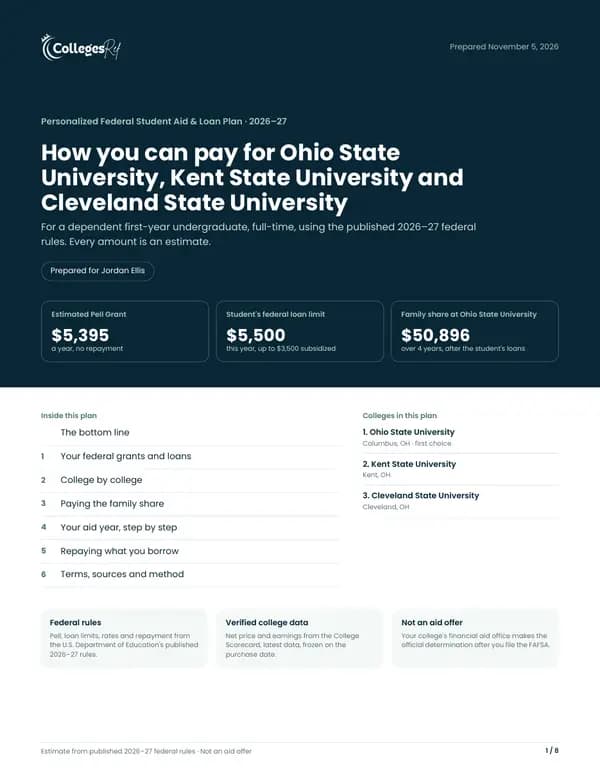
The amount of federal debt an undergraduate accumulates depends directly on statutory caps set by Congress. For dependent students, the U.S. Department of Education limits Direct Subsidized and Unsubsidized Loans to $5,500 in the first year. This cap rises to $6,500 in the second year and $7,500 in both the third and fourth years. Over a standard four-year enrollment, a dependent student can borrow a maximum of $27,000, as detailed on studentaid.gov.
If a student requires a fifth year to complete their degree, the lifetime aggregate limit for dependent undergraduates caps total borrowing at $31,000. No more than $23,000 of this total may consist of subsidized loans. Because these statutory caps prevent students from borrowing the full cost of attendance on their own, the national median graduate debt remains anchored below these limits. Families can use these fixed limits to estimate monthly loan payments before signing their annual Master Promissory Note.
Borrowing Allowances for Independent Undergraduates
Students classified as independent for federal financial aid purposes have access to higher borrowing limits to compensate for the absence of Student Aid Index (SAI). According to federal guidelines, independent undergraduates can borrow up to $9,500 in their first year, with a maximum of $3,500 in subsidized loans. This annual limit increases to $10,500 in the second year and $12,500 in the third year and beyond.
The lifetime aggregate limit for independent undergraduate borrowers is $57,500. This higher threshold often leads to significantly larger debt loads at graduation for non-traditional students. To determine your dependency status, review the specific dependency questions on Step Three of your Free Application for Federal Student Aid (FAFSA). If you answer "no" to all questions but have unusual circumstances, you must request a written Dependency Override review directly from your college financial aid office.
The Impact of Parent PLUS and Graduate Loan Caps
When federal student loans do not cover the cost of attendance, families often turn to parent borrowing. For loans first disbursed on or after July 1, 2026, Parent PLUS borrowing is capped at $20,000 per year and $65,000 in total per dependent student, according to studentaid.gov. These caps prevent parents from taking on unlimited debt, forcing families to find other ways to cover funding gaps.
To avoid high-interest parent loans, students can target Public Universities With the Lowest Out-of-State Tuition (2026) to keep total costs within federal undergraduate limits. For students planning for advanced degrees, federal rules have also changed. For new borrowers starting July 1, 2026, Grad PLUS loans are eliminated. Graduate students are limited to $20,500 annually in Direct Unsubsidized Loans up to a $100,000 aggregate limit, while professional students are capped at $50,000 annually up to a $200,000 aggregate limit.
Comparing Net Prices at the Nation's Largest Institutions
Net Price Variations Among Major Public and Private Universities
Sticker prices rarely reflect what families actually pay for a college degree. To understand the real cost of attendance, families must look at the average net price. This is the actual amount a student pays after subtracting all federal, state, and institutional grant aid. CollegesRef data from the College Scorecard shows that the national median net price across 1,557 reporting four-year colleges is $19,835.
At the nation's largest public institutions, state funding and large enrollment bases can pull these costs below the national median. For example, Texas A & M University-College Station reports an average net price of $21,527. Meanwhile, Arizona State University Campus Immersion shows an average net price of $14,694.
These net prices are not guaranteed rates. They represent averages across all income brackets. To find your own projected cost, you should use each school's college cost calculator: net price vs sticker price tool. This tool is required by federal law to be hosted on every college's website. When using these calculators, have your family's most recent federal tax returns handy. You will need to input specific figures, such as the adjusted gross income (AGI) from line 11 of IRS Form 1040, to get an accurate estimate.
How Online and Non-Traditional Models Impact Average Costs
Large-scale online and non-traditional universities present a completely different cost structure. These institutions often operate with lower physical overhead, but their average net prices vary widely based on their tax status and instructional models.
Western Governors University, a private nonprofit institution known for its competency-based online model, reports an average net price of $12,748. In contrast, Southern New Hampshire University, which has grown into one of the largest private nonprofit online providers in the country, has an average net price of $36,764.
For-profit institutions also show significant variation. The University of Phoenix-Arizona reports an average net price of $13,916, while Grand Canyon University, a large private Christian university, has an average net price of $21,509.
When evaluating these non-traditional options, applicants should look closely at how the school packages its Financial Aid awards. Some online programs charge flat-rate tuition per term rather than per credit hour. This model can lower your total debt if you complete your courses quickly.
Before signing a master promissory note, contact the financial aid office of your chosen institution. Ask them for a written breakdown of the "Cost of Attendance" (COA) versus the "Direct Costs" that will appear on your bill. Specifically, ask if their net price calculation includes indirect costs like off-campus housing, books, and technology fees, or if those expenses will require additional out-of-pocket borrowing.
How to Research and Compare Individual College Debt Figures
Locating College Scorecard Debt and Earnings Data
Families can find official, institution-level debt and earnings data directly through the College Scorecard website maintained by the U.S. Department of Education at https://collegescorecard.ed.gov/data/. When researching a specific institution, look for the "Financial Aid and Debt" section of the college profile. This section displays the median cumulative federal debt of undergraduate borrowers who graduated.
To make a realistic financial plan, request the College Financing Plan from the financial aid office of each school on an applicant's list. This standardized form displays the estimated net price alongside recommended federal student loan options. Because the official federal database only tracks federal student loans, families must ask the financial aid office for the percentage of graduates who take out private loans and the average private debt load. This step is critical because private loans do not carry the same flexible repayment options as federal programs.
Using the CollegesRef Student Loan Limits Tool
To understand how much of a college's net price can be covered by federal student aid, families can use the CollegesRef Student Loan Limits tool at /tools/student-loan-limits. This tool helps families calculate their maximum federal borrowing capacity based on the student's dependency status and year in school.
Subtracting the maximum annual federal loan limit from the actual net price of the college reveals the remaining funding gap. This gap must be covered by family savings, work-study earnings, private loans, or parent borrowing. When evaluating how to cover this gap, families should compare the sticker price vs net price by state to see how regional pricing trends and state grant programs affect the out-of-pocket costs at similar institutions.
Evaluating the Debt-to-Earnings Ratio for Your Major
A graduate's ability to repay student loans depends heavily on their starting salary, which varies more by major than by the institution attended. To evaluate whether a projected debt load is manageable, calculate the debt-to-earnings ratio by dividing the expected total debt at graduation by the projected first-year salary.
A standard rule of thumb is that total student debt should not exceed a graduate's expected starting annual salary. For detailed guidelines on what constitutes a safe borrowing level based on historical employment data, families can consult the guide on How Much Student Debt Is Too Much? Debt-to-Earnings Benchmarks From Federal Data. If the projected debt at a chosen college exceeds the median starting salary for that major, the student should consider lower-cost alternatives, such as attending a public in-state university or completing general education requirements at a community college before transferring.
Hypothetical Borrowing Scenarios for Undergraduate Students
A dependent student choosing between public and private nonprofit options
Assume all household income and family contribution figures in this scenario are hypothetical. A dependent student is admitted to an in-state public university and a private nonprofit college. The public university has an average net price of $10,516, which matches the public college median in the CollegesRef data. The private nonprofit college has an average net price of $27,122, matching the private nonprofit median.
First, the family reviews the student's federal aid eligibility. According to studentaid.gov, the maximum Federal Pell Grant is $7,395, but this student does not qualify for the full amount due to family income. Second, the student calculates the maximum federal borrowing allowed for a dependent undergraduate. Under federal rules, a first-year dependent student can borrow a maximum of $5,500 in Direct Loans. Third, the family subtracts the federal loan and their out-of-pocket contribution of $5,000 from each net price.
For the public university, the calculation is $10,516 minus $5,500 minus $5,000, leaving a remaining balance of $16. The student can cover this small gap with a part-time summer job. For the private nonprofit college, the calculation is $27,122 minus $5,500 minus $5,000, leaving an unfunded gap of $16,622 for the first year alone.
The student decides to enroll in the public university. Choosing the private college would require the parents to take out a Parent PLUS loan or force the student to seek private loans. By choosing the public option, the student can graduate with total federal debt well below the four-year dependent limit of $27,000.
An independent student attending a private for-profit institution
Assume all household income and family contribution figures in this scenario are hypothetical. An independent adult student plans to enroll in a private for-profit college. CollegesRef data shows the median average net price for private for-profit colleges is $27,612.
First, the student checks their independent status on the Free Application for Federal Student Aid (FAFSA). Because they are independent, they have higher federal loan limits. Second, the student looks up the first-year independent borrowing limit on studentaid.gov, which is $9,500. Third, the student qualifies for a partial Federal Pell Grant of $4,000 based on their tax return. Fourth, the student subtracts the Pell Grant and the maximum first-year federal loan from the net price: $27,612 minus $4,000 minus $9,500.
The student realizes that even with the higher independent loan limits, they cannot cover the cost of attendance without external funding. Private for-profit colleges in the CollegesRef data have a median graduation rate of 42% and median earnings of $45,510 ten years after entry.
The student decides to decline the offer and enrolls in a local public college instead. The public college median net price of $10,516 allows the student to cover their entire tuition and fees using only federal grants and a portion of their federal student loans, avoiding high-interest private debt.
A dependent student comparing two out-of-state public universities
Assume all household income and family contribution figures in this scenario are hypothetical. A student is comparing Western Governors University and Southern New Hampshire University. According to CollegesRef data, Western Governors University has an average net price of $12,748, while Southern New Hampshire University has an average net price of $36,764.
First, the student notes that they do not qualify for any federal grant aid. Second, the student applies the federal dependent loan limit of $5,500 for the first year. Third, the student's parents agree to contribute exactly $7,500 toward tuition.
For Western Governors University, the student subtracts the loan and parent contribution from the net price: $12,748 minus $5,500 minus $7,500.
The student chooses Western Governors University because it allows them to graduate with minimal debt. The Southern New Hampshire University option would require the parents to borrow near the Parent PLUS annual cap of $20,000.
To estimate your own annual and cumulative borrowing limits, enter your dependency status and graduation timeline into the CollegesRef Student Loan Limits.