

To request a financial aid review after receiving a low Early Decision offer, a student must immediately contact the college's financial aid office to ask for a professional judgment review. The applicant must submit a formal appeal letter detailing specific changes in family financial circumstances, accompanied by supporting documentation like recent tax transcripts or medical bills. This request must occur before the college's early enrollment deposit deadline, which typically falls in January.
This process is critical for families who find that the actual financial aid award letter does not match the estimate from the college's net price calculator. Many families mistakenly believe that an Early Decision agreement forces them to accept an unaffordable offer. In reality, colleges will release an applicant from the binding Early Decision contract if the financial aid office cannot close the gap between the offered aid and the family's documented financial need.
Key takeaways
- Contact the financial aid office immediately to request a professional judgment review before the early enrollment deposit deadline in January.
- Compare your FAFSA and CSS Profile entries against the net price calculator to identify asset or non-custodial parent income discrepancies.
- The national median net price after grants at four-year colleges is $19,835 according to CollegesRef data.
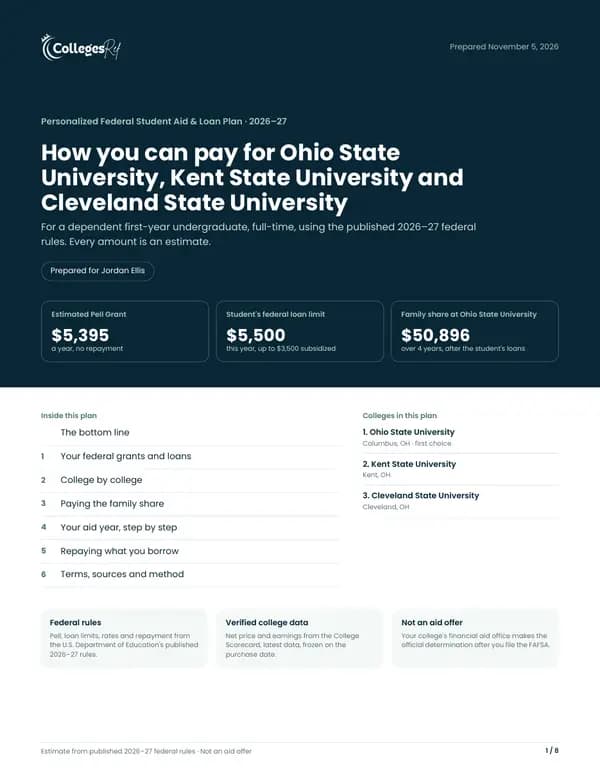
- First-year dependent undergraduates can borrow a maximum of $5,500 in Direct Loans according to studentaid.gov.
- Colleges must release an applicant from the binding Early Decision contract if the financial aid office cannot make the offer affordable.
What to Do When Your Early Decision Financial Aid Is Too Low
The Immediate Steps After Receiving Your December Aid Letter
When an Early Decision (ED) acceptance arrives mid-December, the financial aid offer letter arrives with it or follows within days. A family must immediately locate the "Net Cost" or "Net Price" line on the aid letter, which subtracts only grants and scholarships from the total cost of attendance. Do not subtract student loans or Federal Work-Study from this line, as these items represent debt or potential earnings rather than a reduction in price.
If this net cost exceeds what the household can pay, locate the specific financial aid officer assigned to the applicant's file. This name is often listed at the bottom of the award letter or on the student portal. If no name is listed, call the main financial aid office to ask for the name and direct email address of the officer responsible for regional ED admits. Request a copy of the institution's official financial aid appeal form, which some campuses call a Special Circumstances Petition or a Financial Aid Review Request.
To see how your net cost compares to federal averages for your income level, use the CollegesRef Affordability Check. This tool compares a college's net price against a family's budget using federal net price data, though it does not predict individual institutional decisions.
Understanding Your Rights Under the Early Decision Agreement
The Early Decision agreement is a binding contract signed by the student, a parent, and a high school counselor. However, every standard ED agreement contains a clear exit clause for financial need. If a college's financial aid office cannot provide an award package that makes attendance possible, the student is permitted to decline the offer of admission and be released from the binding commitment.
A family does not violate the ethical terms of the agreement by requesting a review or, if that review fails, by withdrawing their application. You must not, however, submit applications to other institutions until the ED college officially releases the student from the contract in writing. For more details on managing these agreements, browse the Financial Aid resources.
How the Enrollment Deposit Deadline Affects Your Timeline
Early Decision enrollment deposits are typically due by mid-January, giving families roughly three to four weeks to resolve aid discrepancies. This tight window requires immediate action. Once an applicant receives an insufficient offer, they have about ten business days to gather documentation, submit a formal review request, and receive a decision before the deposit deadline.
When contacting the financial aid office, ask for a temporary extension on the enrollment deposit deadline while the review is active. Most colleges will grant a one-week or two-week extension to ED students who are actively engaged in a documented financial review. This extension prevents the student from losing their spot in the incoming class while the office evaluates the request. Keep all communications in writing, and note the exact date and time of every phone call with the office.
Why Your ED Aid Package Is Lower Than the Net Price Calculator
An Early Decision financial aid offer that falls short of a college's Net Price Calculator (NPC) estimate usually stems from how specific financial data points are entered or interpreted. The NPC is a planning tool, not a binding contract. When the financial aid office reviews your actual tax returns and asset statements, they often find details that the simplified calculator questions missed. Understanding these discrepancies is the first step toward requesting a formal review of your package.
Identifying Discrepancies in Asset and Income Reporting
Discrepancies often begin with how families enter their financial data on federal and institutional aid applications. If you received your acceptance during the December release window, you can learn more about what each early decision outcome means for your enrollment timeline.
To find the source of a low aid offer, compare the exact line items you entered into the NPC against your completed Free Application for Federal Student Aid (FAFSA) and the College Board's CSS Profile. Look closely at your adjusted gross income, taxable interest, and untaxed income. A common error occurs when families report retirement accounts, such as a 401(k) or IRA, as investment assets on the FAFSA. Federal rules exclude qualified retirement assets from the student aid index calculation. If you mistakenly listed these balances in the investment field, the college's system will artificially inflate your family's financial strength.
How Colleges Treat Home Equity and Business Income
The FAFSA and the CSS Profile handle primary home equity and small business assets in fundamentally different ways. You can read about these differences in our guide on CSS Profile vs FAFSA: What Each Form Asks and Who Needs Both.
While the FAFSA excludes the equity of a primary residence and family-owned businesses with fewer than 100 employees, many private colleges use the CSS Profile to assess these assets. If the college uses an institutional methodology, they may calculate your home equity by subtracting your outstanding mortgage balance from the home's current market value, often sourced from databases like Zillow or local tax assessments. If the college's valuation of your home is higher than its actual market value, your calculated need will drop. You can calculate your actual equity by obtaining a recent local property tax assessment or a professional appraisal to submit as corrective documentation to the financial aid office.
The Impact of Non-Custodial Parent Financial Profiles
For students with divorced or separated parents, the inclusion of a non-custodial parent's income and assets is a frequent cause of unexpectedly low aid packages. The FAFSA only requires financial information from the parent who provides the greater portion of the student's financial support.
However, many private colleges requiring the CSS Profile demand a separate financial statement from the non-custodial parent. If your NPC calculation was completed using only the custodial parent's financial information, but the college subsequently factored in the non-custodial parent's salary, home equity, and savings, the final aid offer will be significantly lower than the initial estimate. If you have had no contact with your non-custodial parent for years, you must ask the financial aid office for their specific Non-Custodial Parent Waiver Petition form to request an exemption.
Comparing Your Offer to Federal and Sector Benchmarks
Evaluating the Offer Against National Net Price Medians
To determine if an Early Decision financial aid offer is unusually low, a family must compare their net price to national benchmarks. The net price is the total cost of attendance minus all grants and scholarships. According to CollegesRef data, the national median net price at four-year colleges is $19,835. If the net price on your December financial aid letter is significantly higher than this national median, or higher than the estimate you received when researching why net price calculator estimates differ, you have a concrete starting point for your inquiry.
Calculate your net price by locating the "Total Cost of Attendance" line on your aid letter and subtracting the total of the "Grants and Scholarships" section. Do not subtract student loans or work-study offers. If the resulting figure exceeds your family's calculated expected contribution, you must prepare to ask the financial aid office for a formal review.
Using the CollegesRef Affordability Check to Assess the Gap
Families can evaluate how their offer aligns with federal data by using the CollegesRef Affordability Check. This tool compares a college's net price against a family's budget using federal net price data. By comparing your actual Early Decision offer to the average net price for your income bracket, you can identify whether the college has departed from its typical funding patterns.
If the tool reveals that your offer is thousands of dollars higher than the average net price for families in your exact income band, you can use this discrepancy as objective evidence. When you contact the financial aid office, you can present this gap not as a demand, but as a question about which specific data point on your Institutional Methodology profile caused the deviation.
Analyzing Net Price Differences by Institutional Sector
The financial expectations placed on a family vary dramatically depending on the type of college. As shown in the table below, the median average net price for private nonprofit colleges is $27,122, which is more than double the public college median of $10,516. Private nonprofit institutions often have higher graduation rates, with a median of 70% compared to 42% at public institutions, but they require a much larger upfront financial commitment.
For example, a student admitted to a large private nonprofit institution like Southern New Hampshire University, which has an average net price of $36,764 according to CollegesRef data, faces a very different financial reality than one attending a public institution. If your Early Decision offer at a private nonprofit college leaves you with a funding gap that requires borrowing beyond federal limits, you must evaluate the long-term impact. Under studentaid.gov guidelines, first-year dependent undergraduates can borrow a maximum of $5,500 in Direct Loans. If the college expects your parents to cover the remaining gap through Parent PLUS loans, which are capped at $20,000 per year for loans disbursed on or after July 1, 2026, you should review How Much Student Debt Is Too Much? Debt-to-Earnings Benchmarks From Federal Data before signing the enrollment agreement.
Colleges in this article

Federal IPEDS and College Scorecard data on CollegesRef. Net price is the average paid after grants by first-time, full-time students who receive aid.
| Sector | Colleges | Median net price | Median in-state tuition | Median out-of-state tuition | Median graduation rate | Median earnings (10 yrs) |
|---|---|---|---|---|---|---|
| Public | 1,054 | $10,516 | $6,089 | $12,656 | 42% | $49,519 |
| Private nonprofit | 326 | $27,122 | $48,600 | $48,600 | 70% | $69,642 |
| Private for-profit | 62 | $27,612 | $17,370 | $17,370 | 42% | $45,510 |
Source: CollegesRef analysis of IPEDS and College Scorecard data for 1,442 published U.S. colleges with at least 2,000 students (latest data year 2025). Net price is the average paid by first-time, full-time students who receive grant aid.
At a glance
Average net price for the colleges in this list
- Western Governors University
- $12,748
- Grand Canyon University
- $21,509
How to Ask a College to Review Your Financial Aid Offer
Contacting the Financial Aid Office the Right Way
A student must contact the financial aid office directly to initiate an appeal. Do not send this request to the admissions office. Admissions officers do not calculate financial aid packages or manage institutional budgets.
First, check the college's financial aid website for a formal "Professional Judgment" or "Financial Aid Appeal" form. Many institutions require applicants to submit a specific PDF or online form before they will look at any supporting documents. If no form exists, find the email address for the financial aid counselor assigned to the student's last name or geographic region.
Call the office to confirm the name of the person who will review the file. Ask this specific question: "What is the deadline for submitting an appeal for an Early Decision applicant?" Because Early Decision deposit deadlines usually fall in January, the window for a review is narrow.
Gathering the Required Verification and Tax Documents
Colleges will not adjust an aid package based on verbal claims. A family must provide documented proof of any financial changes that occurred after filing the FAFSA or CSS Profile.
Gather these specific documents:
- Signed copies of federal tax returns (Form 1040) and all accompanying schedules from the relevant tax year.
- W-2 forms for both parents.
- Recent pay stubs showing a reduction in year-to-date earnings.
- Unbiased third-party documentation, such as a termination letter, medical bills not covered by insurance, or a death certificate.
If the discrepancy stems from an asset valuation error on the initial application, collect bank statements or property appraisals that show the correct figures. Keep in mind that colleges have different policies regarding home equity and non-custodial assets. Reviewing the CSS Profile deadlines and institutional rules can help identify which forms require correction.
Drafting a Short and Professional Review Request
Keep the written request brief, factual, and polite. Avoid emotional language or complaints about the college's pricing. State the exact dollar amount the family can realistically pay annually, and back this number up with the documented changes in income or assets.
Use this template to structure the email:
Subject: Financial Aid Review Request - [Student Name] - [Application ID]
Dear [Name of Financial Aid Counselor or "Financial Aid Committee"],
Thank you for admitting me to [College Name] under Early Decision. I am eager to enroll, but my family has experienced a significant change in financial circumstances since we submitted our financial aid applications.
Specifically, [state the issue clearly, e.g., my parent experienced a 30% reduction in salary in October 2025, or we incurred $12,000 in out-of-pocket medical expenses this year]. Due to these circumstances, our calculated family contribution is not feasible.
We have completed the college's formal appeal form and attached the supporting tax documents and pay stubs. Based on our current financial situation, we can contribute [Insert Dollar Amount] annually. We welcome the opportunity to discuss whether a professional judgment review is possible.
Sincerely,
[Student Name and Parent Name] [Phone Number]
This clear approach shows the office that the student is committed to enrolling if the financial gap can be closed. For context on how state-level funding and institutional grants impact these final costs, families can compare regional aid trends in our guide on Sticker Price vs Net Price by State: Where Grants Cut College Costs Most.
The Mechanics of a Federal Financial Aid Review
Understanding FAFSA Corrections and Professional Judgment
A college financial aid office cannot change the federal aid formula, but administrators can adjust the data elements used to calculate eligibility. Under Section 479A of the Higher Education Act, financial aid administrators possess the authority to exercise professional judgment. This process allows them to adjust the data on the Free Application for Federal Student Aid (FAFSA) to reflect special circumstances, such as a sudden loss of employment or unusual medical expenses.
To initiate this, a student must submit a formal request for a professional judgment review directly to the financial aid office. Do not submit a standard FAFSA correction on studentaid.gov for these types of changes. Federal guidelines require the college to review the documentation first and submit the official adjustment. An applicant must provide tax transcripts, recent pay stubs, or termination letters to support the claim. When comparing costs across institutions, families may find that some private schools offer more flexibility in how they assess financial need. Families looking for options with lower baseline costs can consult the list of the Most Affordable Private Colleges by Net Price (2026) to evaluate alternative institutions.
Federal Student Loan Limits for Dependent Undergraduates
When a college reviews a financial aid package, they may adjust the mix of grants and loans. Federal student loans have strict statutory limits that the financial aid office cannot exceed, regardless of a family's financial need. According to https://studentaid.gov/understand-aid/types/loans/subsidized-unsubsidized, the Direct Loan annual limit for a dependent undergraduate in their first year is $5,500.
This limit increases to $6,500 in the second year and $7,500 in the third year and beyond. Over the course of four years, a dependent undergraduate student can borrow a maximum of $27,000 under these federal guidelines. If the financial aid package already includes these maximum amounts, the college cannot add more federal student loans to close the funding gap. Any additional self-help aid must come from institutional loans, private loans, or work-study funding.
The Role of Parent PLUS Loans and Federal Pell Grants
If a family still faces a funding gap after federal student loans are applied, the college may include a Federal Parent PLUS Loan in the financial aid package. According to https://studentaid.gov/understand-aid/types/loans/plus/parent, for loans first disbursed on or after July 1, 2026, Parent PLUS borrowing is capped at $20,000 per year and $65,000 in total per dependent student. This cap represents a significant shift in how families must plan for multi-year education costs. Parents can no longer borrow up to the full cost of attendance through this federal program.
For low-income students, the financial aid office will also verify eligibility for the Federal Pell Grant. According to https://studentaid.gov/understand-aid/types/grants/pell, the maximum Federal Pell Grant for the 2026-27 award year is $7,395. If family income sits just above the threshold for federal grant eligibility, a student may experience a steeper funding gap. This is a common pattern in national pricing trends, particularly in sectors where middle-income families pay more due to the rapid phase-out of need-based state and federal grants. When requesting a review, ask the financial aid officer to clarify whether the student qualifies for even a partial Pell Grant, as this designation often triggers additional institutional matching funds.
What to Do If the Financial Aid Review Does Not Close the Gap
Requesting a Formal Release From the Early Decision Agreement
If the financial aid office denies the appeal or offers an adjustment that still leaves the college unaffordable, an applicant must act quickly to secure a release from the Early Decision (ED) contract. Students are not legally bound to attend a college that they cannot afford. Families must handle the exit process correctly to avoid administrative penalties.
Contact the admissions office immediately by email and phone to state that the financial aid package does not make attendance possible. Request a formal release from the Early Decision agreement based on financial hardship. The admissions office will typically send a release form or confirm the release via email. This document must be signed by the student, a parent, and the high school guidance counselor. Do not simply ignore the enrollment deposit deadline. An applicant must secure this official release before depositing at any other institution.
Applying to Peer Institutions During the Regular Decision Cycle
Once the college releases the student from the ED agreement, they can immediately submit applications to other institutions. Because ED results typically arrive in mid-December, applicants will still have time to meet the January 1 or January 15 Regular Decision deadlines for peer colleges.
When applying to new schools, use a four-year cost estimate to project total out-of-pocket expenses before submitting each application. This calculation helps families avoid repeating the same financial mismatch. Run the net price calculator for every new college on the list and save a PDF copy of each result. If a peer institution later offers a more competitive aid package, a student can use that offer as a point of comparison when requesting a financial aid review at another school.
Evaluating Public and Private Options for the Upcoming Academic Year
A failed ED appeal requires a broadening of the college list to include more financially predictable options. Private nonprofit colleges have a median average net price of $27,122 according to CollegesRef data, which may remain out of reach without significant institutional aid. Public universities present a different financial profile, with a median in-state tuition of $6,089 and a median out-of-state tuition of $12,656.
If an applicant must look outside their home state, research Public Universities With the Lowest Out-of-State Tuition (2026) to find institutions where the baseline cost is low even without institutional grants. Ensure the list includes at least two financial safety schools. These are institutions where the student's academic profile places them in the top tier of applicants for automatic merit scholarships, or where the published in-state cost fits comfortably within the family budget.
Three Real-World Scenarios for Early Decision Aid Appeals
A Middle-Income Family Facing Uncounted Business Expenses
This scenario uses hypothetical household figures to show how a family business can skew an initial financial aid offer. The Miller family has an adjusted gross income of $95,000. Their child was accepted Early Decision to a private nonprofit college with an initial financial aid offer that left them with a net price of $38,000. This net price is significantly higher than the median average net price of $27,122 for private nonprofit colleges in the CollegesRef 2026–27 edition. The college used the CSS Profile, which factored in the gross assets of Mr. Miller’s small landscaping business without deducting the outstanding commercial vehicle loans.
First, the family gathered their Schedule C from their federal tax return and the outstanding loan statements for the business equipment. Second, they wrote a concise letter to the financial aid office. They explained that the business assets are tied up in illiquid equipment with $40,000 in remaining debt. Third, they submitted these documents through the college's secure upload portal. The financial aid office reviewed the liabilities and adjusted the family's asset calculation. The college increased its institutional grant by $9,000. This adjustment brought the final net price down to $29,000. The family accepted the revised offer and paid the enrollment deposit.
A Dependent Student Maximizing Federal Loan Limits
This scenario uses hypothetical household figures to show how a student can structure their aid when institutional grants are capped. Sarah was accepted Early Decision to a public university. Her family's adjusted gross income is $65,000. The university offered an institutional grant of $2,000, leaving a net price of $15,000. This is higher than the median average net price of $10,516 for public colleges in the CollegesRef 2026–27 edition. The family could not afford the remaining balance out of pocket and did not qualify for a Federal Pell Grant, which has a maximum value of $7,395 for the 2026-27 award year according to studentaid.gov.
First, Sarah checked the federal student loan limits on studentaid.gov. As a dependent first-year undergraduate, her annual Direct Loan limit is $5,500. Second, her parents reviewed the Parent PLUS loan limits. According to studentaid.gov, Parent PLUS borrowing is capped at $20,000 per year for loans first disbursed on or after July 1, 2026. Third, the family calculated that taking the $5,500 student loan and a $4,500 Parent PLUS loan would cover the remaining $10,000 gap without exceeding federal limits. Because the total debt remained within their planned budget, they decided to accept the Early Decision offer and commit to the university.
A Family Navigating a Sudden Change in Income
This scenario uses hypothetical household figures to demonstrate an appeal based on a recent job loss. The Rahman family has a historical adjusted gross income of $120,000. Their child was accepted Early Decision to a private nonprofit university. The initial aid offer was based on tax data from two years prior, resulting in a net price of $42,000. However, Mrs. Rahman was laid off in November, reducing the household's current annual income to $55,000.
First, the family collected Mrs. Rahman’s termination letter, her final pay stub, and her state unemployment benefit statements. Second, they contacted the financial aid office to request a professional judgment review due to special circumstances. Third, they submitted a copy of their projected income statement for the upcoming year along with the termination documentation. The financial aid administrator verified the job loss and recalculated their financial need using the lower estimated income. The university revised the financial aid package, adding a $15,000 institutional need-based grant. This brought the net price down to $27,000, which is just below the private nonprofit median of $27,122 in the CollegesRef 2026–27 edition. The family accepted the revised offer.
You can compare these scenario benchmarks against your own financial aid offers by using the CollegesRef Affordability Check.