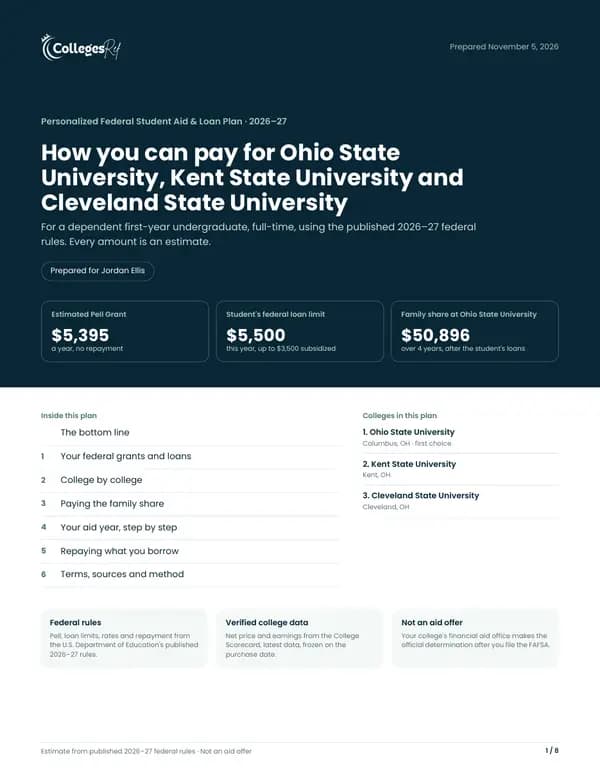


For Federal Direct Parent PLUS Loans first disbursed on or after July 1, 2026, parents can borrow a maximum of $20,000 per year for each dependent student. The federal government also imposes a lifetime limit of $65,000 per dependent student. These limits represent a major policy shift, ending the historical practice of allowing parents to borrow up to the full cost of attendance.
This change impacts families comparing financial aid offers for the 2027–28 academic year. Many parents mistakenly believe they can automatically borrow the full difference between their child's financial aid package and the college's published price. Under the new rules published on fsapartners.ed.gov, a family facing a $30,000 funding gap after student loans and grants cannot use Parent PLUS Loans to cover the entire balance. The annual $20,000 cap per student applies regardless of the family's income, credit score, or the actual cost of the institution.
Key takeaways
- Starting July 1, 2026, federal Parent PLUS Loans are capped at $20,000 annually and $65,000 in total per dependent student.
- The national median net price of $19,835 at four-year colleges sits just under the new annual Parent PLUS borrowing limit.
- Dependent undergraduate students can only borrow between $5,500 and $7,500 annually in federal Direct Loans to help cover college costs.
- At private nonprofit colleges, the median net price of $27,122 leaves a funding gap that exceeds the annual $20,000 parent loan cap.
- Parent PLUS Loans disbursed after July 1, 2026, are excluded from the new federal Repayment Assistance Plan.
The New Federal Parent PLUS Loan Limits for 2026 and Beyond
Federal borrowing rules for parents have changed. For federal Parent PLUS Loans first disbursed on or after July 1, 2026, the Department of Education has established strict borrowing caps. Previously, parents could borrow up to the full cost of attendance determined by the school, minus any other financial aid received. Under the new regulations, families must plan for both yearly and cumulative restrictions on their federal educational debt.
The $20,000 Annual Borrowing Cap
For any loan first disbursed on or after July 1, 2026, the annual Parent PLUS Loan limit is capped at $20,000 per dependent student. This policy applies regardless of the institution's tuition rate or the family's calculated financial need. According to official guidelines on fsapartners.ed.gov, this limit is tied to the individual student rather than the parent borrower.
If two parents borrow separately for the same child, their combined Parent PLUS borrowing for that academic year cannot exceed the $20,000 threshold. To verify how this annual cap interacts with other federal student loans, families can use the CollegesRef Federal Loan Limits tool to view the maximum borrowing amounts allowed for both dependent students and their parents. This tool displays current statutory limits but does not calculate individual school costs or private financing options.
When reviewing the financial aid offer from a college, families should locate the line item for the Parent PLUS Loan. If the school has packaged a Parent PLUS Loan that exceeds $20,000 for the 2026–27 academic year, the family must contact the financial aid office to request a revised award letter reflecting the legal maximum.
The $65,000 Lifetime Aggregate Limit per Student
In addition to the yearly cap, the federal government now imposes a lifetime aggregate limit of $65,000 in Parent PLUS Loans per dependent student. This limit is documented by studentaid.gov. If a student enrolled in a four-year undergraduate program requires maximum Parent PLUS borrowing each year, the family will reach the $65,000 cumulative limit during the student's fourth year of study.
This aggregate cap is tracked through the National Student Loan Data System (NSLDS). Parents can log into their studentaid.gov dashboard using their Federal Student Aid (FSA) ID to monitor their outstanding cumulative balance.
For families with multiple children in college, the aggregate limit applies individually to each dependent student. A parent borrowing for two children simultaneously has a separate $65,000 limit for each child, allowing a total aggregate borrowing capacity of $130,000 across both students.
When planning for a four-year degree, families must calculate the projected funding gap across all years of enrollment. Relying solely on Parent PLUS Loans to cover a consistent annual gap of $20,000 will leave a $15,000 deficit in the final year of a four-year program. Families can read more about managing these funding gaps in our guide to Financial Aid.
How the Cost of Attendance Still Restricts Your Annual Borrowing
Calculating Net Price Minus Other Financial Aid
The new federal borrowing caps do not replace the traditional calculation used by campus financial aid offices. Even with the annual limit set at $20,000, a parent cannot simply request this maximum amount. Federal law dictates that the absolute limit for a Parent PLUS loan in any single academic year is the school's official Cost of Attendance (COA) minus all other financial aid the student receives.
To find these figures, families must look at the official financial aid award letter issued by the college's financial aid office. The COA is not just tuition. It is a comprehensive figure that includes tuition, mandatory fees, housing, food, books, supplies, and estimated personal travel expenses. From this total COA, the financial aid office subtracts any Pell Grants, state grants, institutional scholarships, and the student's own federal Direct Loans.
Families can estimate these calculations early by reviewing how CSS Profile vs FAFSA: What Each Form Asks and Who Needs Both affects the institutional and federal aid calculations that determine the final net price.
Why the Actual Loan Amount May Be Lower Than the Cap
The federal formula ensures that a family cannot over-borrow beyond the federally defined cost of education. This secondary restriction is highly relevant for families choosing lower-cost institutions, such as in-state public universities.
If the calculated gap between the COA and other financial aid is only $8,000, then $8,000 is the maximum Parent PLUS loan limit for that year. The school's financial aid certification system will automatically block any loan application that exceeds this calculated gap. The financial aid office certifies the loan amount directly with the U.S. Department of Education before any funds are disbursed.
Families must also account for the federal loan origination fee, which is deducted from the loan proceeds before disbursement. This means the actual cash applied to the student's billing account will be slightly lower than the approved loan amount.
To determine the exact amount needed, parents should request a "billing worksheet" or "estimated bill" directly from the bursar's office. This document shows the direct charges (tuition, fees, campus housing, and meal plans) rather than the indirect estimates (books and travel) included in the COA. Comparing the actual bill to the net aid package prevents families from borrowing more than necessary, even when the federal caps allow for higher limits. Understanding how federal student loans are changing helps families map out these borrowing limits over a full four-year degree.
Comparing College Costs and Net Prices Across Higher Education Sectors
Public versus Private Nonprofit Expenses
The sector of higher education a student chooses directly dictates whether the new federal borrowing caps will disrupt their funding plan. According to CollegesRef data, the national median net price after grants at four-year colleges is $19,835. However, this national figure masks massive differences between public and private institutions.
As shown in the table below, public colleges carry a median in-state tuition of $6,089 and a median average net price of $10,516. At these institutions, the annual Parent PLUS loan limit of $20,000 will easily cover the remaining net price for most families. The situation changes drastically at private nonprofit colleges. These schools have a median in-state tuition of $48,600 and a median average net price of $27,122. Because the median net price at private nonprofits exceeds the $20,000 annual Parent PLUS cap by more than $7,000, families relying solely on federal loans to bridge the gap will face immediate shortfalls.
To determine your specific exposure, locate the "Net Price" line on your student's financial aid award letter. Subtract the student's own federal student loans from this net price. If the remaining balance is higher than $20,000, you cannot rely on federal parent loans alone to cover the bill.
How Net Price Affects the Need for Parent PLUS Loans
A family's need to borrow depends heavily on the actual net price of the chosen institution rather than its sticker price. For example, Southern New Hampshire University, a large private nonprofit institution, has an average net price of $36,764 according to CollegesRef data. A student attending this institution who receives no institutional grants would face costs far exceeding the federal limits.
Colleges in this article

Southern New Hampshire University
Manchester, NH
- Admit rate
- 100%
- Net price
- $36,764
- Grad rate
- 42%

Arizona State University Campus Immersion
Tempe, AZ
- Admit rate
- 90%
- Net price
- $14,694
- Grad rate
- 67%
Federal IPEDS and College Scorecard data on CollegesRef. Net price is the average paid after grants by first-time, full-time students who receive aid.
Under federal guidelines, a dependent undergraduate can only borrow between $5,500 and $7,500 annually in Direct Loans, as detailed on studentaid.gov. When you combine the maximum first-year student limit of $5,500 with the new $20,000 Parent PLUS limit, the maximum total federal borrowing for a dependent student is $25,500 per year. For a school with a net price like Southern New Hampshire University, this leaves an annual funding gap of over $11,000.
Families must weigh these borrowing decisions against future earnings. While private nonprofit colleges boast a median graduation rate of 70% and median 10-year earnings of $69,642, taking on maximum debt remains risky. Parents should review How Much Student Debt Is Too Much? Debt-to-Earnings Benchmarks From Federal Data to evaluate if their projected post-graduation income justifies the debt. Additionally, families must factor in interest; reviewing the 2026–27 federal student loan rates will help calculate the total cost of accumulation over four years.
If the calculations show a gap, email the college financial aid office to ask for a "historical net price sheet" for your specific income bracket. This document will show if the net price is likely to rise in subsequent years, helping you avoid hitting the $65,000 lifetime Parent PLUS limit before graduation.
| Sector | Colleges | Median net price | Median in-state tuition | Median out-of-state tuition | Median graduation rate | Median earnings (10 yrs) |
|---|---|---|---|---|---|---|
| Public | 1,054 | $10,516 | $6,089 | $12,656 | 42% | $49,519 |
| Private nonprofit | 326 | $27,122 | $48,600 | $48,600 | 70% | $69,642 |
| Private for-profit | 62 | $27,612 | $17,370 | $17,370 | 42% | $45,510 |
Source: CollegesRef analysis of IPEDS and College Scorecard data for 1,442 published U.S. colleges with at least 2,000 students (latest data year 2025). Net price is the average paid by first-time, full-time students who receive grant aid.
At a glance
Average net price for the colleges in this list
- Western Governors University
- $12,748
- Grand Canyon University
- $21,509
Repayment Rules and Plan Options for New Parent PLUS Borrowers
The Tiered Standard Repayment Plan
Parents who borrow federal Parent PLUS Loans first disbursed on or after July 1, 2026, will manage their debt under a restructured federal repayment framework. According to the federal guidelines outlined at https://ticas.org/affordability-2/upcoming-changes-to-income-driven-repayment-plans/, new borrowers of federal Direct Loans must choose between two primary repayment pathways. The first pathway is the Tiered Standard Repayment Plan. This plan structures monthly payments based on the total amount of federal debt a borrower accumulates, rather than tying the monthly obligation directly to the borrower's household income.
Under this tiered framework, the repayment term stretches over a designated number of years depending on the outstanding balance. For example, smaller loan balances carry a shorter repayment window, while larger balances near the new $65,000 aggregate limit will trigger a longer repayment schedule. To calculate potential monthly obligations under these tiers, families should request a sample repayment schedule from their federal loan servicer or use the loan simulator tool on studentaid.gov. It is critical to check the "Repayment Plan Selection" form during the exit counseling process to confirm which tier applies to the final borrowed balance. Because these monthly payments are fixed, families must budget for a set monthly cost that begins immediately after the final loan disbursement, unless they formally request an in-school deferment while the student is enrolled at least half-time.
Why Parent PLUS Loans Are Excluded from the Repayment Assistance Plan (RAP)
The second pathway introduced for federal Direct Loans is the Repayment Assistance Plan (RAP). This plan serves as the new income-driven option for federal student borrowers. However, according to policy details from https://ticas.org/affordability-2/upcoming-changes-to-income-driven-repayment-plans/, Parent PLUS Loans are explicitly excluded from participating in the Repayment Assistance Plan. This exclusion means that parent borrowers cannot lower their monthly payments based on their discretionary income or family size through RAP.
This policy exclusion mirrors historical restrictions on parent loans, which have consistently been shut out of the most generous income-driven repayment options. Because of this restriction, families must carefully evaluate their ability to handle fixed monthly payments before signing the Master Promissory Note (MPN). If the fixed payments under the Tiered Standard plan seem unmanageable, families should explore strategies for paying for college without loans to avoid over-borrowing.
When comparing financial aid awards, families can also review Sticker Price vs Net Price by State: Where Grants Cut College Costs Most to find institutions where the actual out-of-pocket cost is low enough to minimize or completely eliminate the need for Parent PLUS borrowing. If a parent still decides to borrow, they must contact their assigned federal loan servicer directly to ask about alternative consolidation options, such as a Direct Consolidation Loan, which historically allowed access to the Income-Contingent Repayment (ICR) plan, though eligibility rules for consolidated parent loans remain highly restrictive.
Transition Rules for Currently Enrolled Students and Multi-Child Families
How the Limits Apply to Existing Borrowers
The introduction of federal borrowing caps represents a major shift for families with students already midway through their undergraduate degrees. According to official guidelines on fsapartners.ed.gov, the $20,000 annual cap and the $65,000 aggregate limit apply strictly to Parent PLUS loans first disbursed on or after July 1, 2026. Any federal Parent PLUS debt a parent accrued before this date does not count toward the new $65,000 lifetime limit.
This grandfathering provision protects families who borrowed heavily during the student's freshman or sophomore years. For example, if a parent borrowed $25,000 annually for the 2024–25 and 2025–28 academic years, that existing $50,000 debt is excluded from the new calculation. Starting July 1, 2026, the parent can still borrow up to the $20,000 annual limit for the student's junior year, and another $20,000 for the senior year, without triggering the $65,000 aggregate ceiling.
To verify how these transition rules affect an ongoing enrollment plan, a parent should log into their dashboard on studentaid.gov to download their complete loan history. Bring this document to a meeting with the financial aid office. Ask the financial aid administrator specifically how the school will package the remaining years of study on the upcoming financial aid award letter, and verify that the system will not erroneously flag pre-2026 debt against the new aggregate limit.
Managing the Cap When Funding Multiple Dependent Students
A crucial detail for families with multiple children in college is that the federal government applies these limits per dependent student, not per parent. If a parent has two children enrolled in college simultaneously, the parent can borrow up to $20,000 annually for each child. The lifetime aggregate limit also scales, allowing a parent to borrow up to $65,000 for the first child and an additional $65,000 for the second child, for a total potential federal debt of $130,000.
Even though the limits scale, borrowing the maximum federal allowance for multiple children can quickly lead to an unsustainable monthly payment. Families must carefully evaluate their total projected debt across all children before signing the Master Promissory Note (MPN) for multiple loans. To evaluate how these combined loan payments will fit into a monthly household budget, families can use the college affordability check to model different borrowing scenarios.
If the combined net price of sending multiple children to college exceeds the federal limits, or if the projected monthly payments are too high, families should compare lower-cost options. For those looking at non-public institutions, reviewing the Most Affordable Private Colleges by Net Price (2026) can help identify schools where the need for Parent PLUS borrowing is greatly reduced or eliminated entirely.
Strategies to Cover a Funding Gap Without Exceeding the Loan Cap
Maximizing Student Direct Loans and Pell Grants
Families must first ensure they exhaust all federal student aid options before looking for external funds. A dependent student should accept the maximum Direct Unsubsidized and Subsidized Loans offered on their financial aid award letter. According to studentaid.gov, these limits are $5,500 for first-year students, $6,500 for second-year students, and $7,500 annually for third-year students and beyond (https://studentaid.gov/understand-aid/types/loans/subsidized-unsubsidized). Over a four-year undergraduate career, a dependent student can borrow a maximum of $27,000 in their own name.
If the family household income qualifies, the student must also secure the Federal Pell Grant. For the 2026-27 award year, the maximum Federal Pell Grant is $7,395, as documented by studentaid.gov (https://studentaid.gov/understand-aid/types/grants/pell). To secure these funds, families must complete the Free Application for Federal Student Aid (FAFSA) annually. If a family experiences a sudden job loss, medical expenses, or a reduction in income not reflected on the tax return used for the FAFSA, they should request a Professional Judgment review from the college financial aid office. This formal appeal can lead to an adjustment of the student's Student Aid Index (SAI) and increase federal or institutional grant aid.
Institutional Payment Plans, Savings, and Lower-Cost Alternatives
When federal student loans and the $20,000 Parent PLUS annual cap do not cover the full cost of attendance, families must look to alternative financing methods. Most college billing offices offer interest-free institutional payment plans. These programs divide the semester tuition bill into three, four, or five monthly installments. Utilizing a payment plan allows families to pay out of current monthly income rather than borrowing. Families can combine these monthly payments with existing 529 savings plan distributions to reduce the overall loan burden. To estimate how different borrowing levels will affect monthly budgets after graduation, families can use the student loan repayment calculator to model future payments.
If the remaining funding gap requires borrowing beyond the federal limits, families should evaluate lower-cost academic pathways. A student can complete general education requirements at a local community college and transfer to a four-year institution. For those seeking a four-year university experience from the start, choosing an in-state public university is often the most economical route. CollegesRef data shows that the median in-state tuition at public colleges is $6,089, compared to a median net price of $27,122 at private nonprofit colleges. Students looking to study out of state can research public institutions that offer tuition waivers or reduced regional rates. Families can compare these options by reviewing Public Universities With the Lowest Out-of-State Tuition (2026) to find campuses that fit within the new federal borrowing limits.
How the New Parent PLUS Loan Caps Work in Practice: Three Family Scenarios
A first-generation student comparing two public in-state offers
All household figures in this scenario are hypothetical. A family with one dependent student is comparing two public in-state options. The student qualifies for the maximum Federal Pell Grant of $7,395, as documented at https://studentaid.gov/understand-aid/types/grants/pell.
First, they look at a college matching the national public median average net price of $10,516. The student borrows the maximum first-year Direct Subsidized Loan of $3,500 and an Unsubsidized Loan of $2,000, totaling $5,500, according to https://studentaid.gov/understand-aid/types/loans/subsidized-unsubsidized. This leaves a remaining net price of $5,016. Because this gap is well below the new annual Parent PLUS cap of $20,000, the parents can cover the entire remaining balance with a Parent PLUS Loan of $5,016.
Second, they look at Arizona State University Campus Immersion, which has a CollegesRef-verified average net price of $14,694. The student again takes the maximum first-year Direct Loan of $5,500. The remaining gap is $9,194. The parents can borrow the full $9,194 through a Parent PLUS Loan because it falls below the $20,000 annual limit. Over four years, if the net price remains stable, the student will borrow the maximum dependent limit of $27,000. This cumulative parent debt remains safely below the new federal aggregate limit of $65,000 per dependent student established at https://fsapartners.ed.gov/sites/default/files/2026-05/FrequentlyAskedQuestionsLoanLimits.pdf. The family decides both options are financially viable under the new rules.
A student attending a high-cost private nonprofit university
All household figures in this scenario are hypothetical. A student plans to attend a private nonprofit university with an average net price matching the sector median of $27,122. The student receives no Pell Grant.
First, the student maximizes their federal borrowing. As a first-year dependent student, they borrow $5,500 in Direct Loans. This leaves a remaining net price gap of $21,622 for the first year.
Second, the parents calculate their maximum borrowing capacity under the new federal limits. According to https://studentaid.gov/understand-aid/types/loans/plus/parent, the Parent PLUS Loan is strictly capped at $20,000 per year.
Third, the family projects these costs over four years. The student will borrow the maximum aggregate limit of $27,000. The parents plan to borrow the maximum annual limit of $20,000 each year. However, in the fourth year, they hit the federal aggregate Parent PLUS limit of $65,000. They can only borrow $5,000 in senior year instead of $20,000. This creates a massive fourth-year gap of $16,622. The family decides this private university is too expensive under the new caps and looks for a lower-cost alternative.
Two siblings enrolled at the same time
All household figures in this scenario are hypothetical. A family has two dependent children entering college in the same academic year. Both children choose to attend Southern New Hampshire University, which has a CollegesRef-verified average net price of $36,764.
First, both students take out the maximum first-year Direct Loan of $5,500 each. This leaves a remaining net price of $31,264 per student.
Second, the parents apply for Parent PLUS Loans. Because the federal limits of $20,000 annually and $65,000 in total apply per dependent student, the parents can borrow up to $20,000 for the first sibling and another $20,000 for the second sibling. This brings their total annual federal borrowing to $40,000.
Third, the parents calculate the remaining gap for each child. With $5,500 in student loans and $20,000 in Parent PLUS Loans, the family has covered $25,500 of the $36,764 net price for each child. The parents realize they cannot bridge this gap with federal loans. They decide to have one child attend a local public college with a median in-state tuition of $6,089 to make the overall household expenses manageable.
You can repeat these steps with your own colleges using the CollegesRef Federal Loan Limits.