

Reserve Officer Training Corps (ROTC) scholarships pay either full tuition and fees or a flat rate for room and board at participating colleges, alongside monthly living stipends. In exchange, students commit to serving as commissioned officers in the military for a set period, typically four years of active duty or eight years in the Reserve or National Guard.
These awards benefit students who want to graduate debt-free and are committed to military service, but families often misunderstand the financial scope. ROTC scholarships do not automatically cover housing and food if a student chooses the tuition option, which can leave a significant funding gap at expensive private universities. Furthermore, if a student leaves the program after the freshman year, the military can require them to repay the scholarship funds or serve on active duty as an enlisted member.
Key takeaways
- ROTC scholarships pay either full tuition and fees or a flat rate for room and board alongside monthly living stipends.
- The Army, Navy, and Air Force branches offer distinct application pathways for high school seniors and currently enrolled college students.
- The Guaranteed Reserve Forces Duty program allows students to serve in the National Guard or Reserves instead of active duty.
- Recipients must pass physical fitness tests, a Department of Defense medical exam, and a structured interview with a senior officer.
- Leaving ROTC after the freshman year can trigger active-duty enlistment or require repayment of all scholarship funds received.
How ROTC Scholarships Pay for College
Reserve Officers' Training Corps (ROTC) scholarships fund undergraduate education in exchange for a commitment to serve as a commissioned officer in the United States military. These awards target tuition and mandatory fees directly, or they can be applied to housing and food. The funding comes from the federal government, but the administration of these funds involves both the campus military science department and the university bursar office.
Tuition and Fees vs. Room and Board Options
An ROTC scholarship recipient must choose how to apply their funding. The primary option covers full tuition and mandatory educational fees, paid directly to the college by the respective military branch. This option does not cover elective fees, such as parking permits or optional health insurance. Alternatively, a student can elect to apply the scholarship toward room and board instead of tuition.
When a student chooses the room and board option, the military branch pays a flat annual amount, which is established by federal regulations and varies by branch. This choice is often financially advantageous for students who receive significant state grants or institutional merit scholarships that already cover tuition. To determine which option yields the lowest out-of-pocket cost, families should request a financial aid worksheet from the college financial aid office and compare the line-item costs for tuition against the campus housing and dining rates.
If you want to search for other funding sources that can combine with these options, you can search verified state and institutional programs using the CollegesRef Scholarships directory to find awards that allow dual-funding.
The Book Allowance and Monthly Living Stipends
In addition to tuition or housing coverage, ROTC scholarship winners receive a flat book allowance. This allowance is paid directly to the student, typically in semester or quarterly installments, to help cover textbooks and required course materials.
Students also receive a monthly subsistence stipend during the academic year, usually paid for up to ten months per year. This stipend increases as the student progresses through their military science curriculum from their freshman to senior year. Because these stipends are paid directly to the student's personal bank account, they are not deducted from the college bill. Students must budget these funds for personal expenses, laundry, and un-reimbursed school supplies.
How Campus-Based and High School Applications Differ
An applicant can secure an ROTC scholarship through two distinct pathways. High school seniors apply through a centralized national selection board during their senior year. This process requires submitting high school transcripts, standardized test scores, physical fitness assessment results, and completing an interview at a local ROTC detachment. National winners receive a scholarship that is tied to specific universities where they have been accepted and where the military branch hosts a unit.
Conversely, students already enrolled in college can apply for campus-based scholarships directly through the university's ROTC department. These on-campus scholarships are often called three-year or two-year side-load scholarships. The professor of military science at the university controls these cadet allocations based on college GPA, physical fitness scores, and performance within the battalion.
To coordinate these awards with federal student aid, applicants must complete the Free Application for Federal Student Aid (FAFSA). You can learn how federal aid calculations differ from private institutional assessments by reading about the CSS Profile vs FAFSA: What Each Form Asks and Who Needs Both.
Comparing Army, Navy, and Air Force ROTC Programs
Army ROTC Scholarship Details and Tiers
The Army ROTC program is the largest of the three branches. It offers both four-year and three-year scholarships to high school seniors through a centralized online portal at goarmy.com. When completing the application, a student must list up to seven universities where they intend to enroll. The Army awards these scholarships in two distinct tiers. The first tier covers full tuition and mandatory fees at the chosen institution. The second tier allows the student to apply the scholarship money toward room and board instead of tuition.
A student must verify whether their chosen school offers an additional room and board incentive. Many universities match the Army ROTC scholarship by providing free housing to cadets. To confirm this benefit, ask the campus military science department for a written copy of their institutional ROTC housing policy. If a student does not receive a high school scholarship, they can apply for a campus-based scholarship through the university's Professor of Military Science during their freshman or sophomore year. These on-campus awards utilize the same tuition or housing payment structures.
Navy and Marine Corps ROTC Scholarship Options
The Navy option includes paths for both Navy and Marine Corps commissions, managed through the NetFocus portal at nrotc.navy.mil. The Navy program places a heavy emphasis on academic majors. It divides applicants into three tiers based on their field of study. Tier 1 is reserved for engineering disciplines. Tier 2 covers science, technology, and mathematics majors. Tier 3 covers humanities and social sciences. The vast majority of Navy-option ROTC scholarships are awarded to students pursuing Tier 1 or Tier 2 technical degrees.
The Marine Corps option does not use these academic tiers. It evaluates applicants primarily on physical fitness and leadership potential. Marine Corps applicants must complete the Marine Corps Physical Fitness Test, which includes pull-ups, crunches, and a three-mile run. Both Navy and Marine Corps scholarship recipients receive full tuition, mandatory fees, and a book allowance. However, these scholarships do not cover room and board. If a student chooses an expensive private university, they must calculate how to fund their housing costs. CollegesRef data shows that private nonprofit colleges have a median average net price of $27,122, making housing a significant out-of-pocket expense.
Air Force and Space Force ROTC Scholarship Types
The Air Force ROTC program, which also commissions officers into the Space Force, manages its applications through afrotc.com. The Air Force utilizes three main scholarship types. Type 1 pays full tuition and authorized fees at any public or private institution with an active detachment. Type 2 caps tuition payments at a specific dollar limit set annually by the Air Force. Type 7 pays 100% of in-state tuition at public universities.
A Type 7 recipient who wants to attend an out-of-state school must convert their award to a three-year Type 2 scholarship. If a student is considering taking out loans to cover the remaining balance of a Type 2 or Type 7 scholarship, they should review How Much Student Debt Is Too Much? Debt-to-Earnings Benchmarks From Federal Data to avoid over-borrowing. Students interested in part-time service can also explore the Army's GRFD ROTC scholarship as an alternative to active-duty tracks.
The Guaranteed Reserve Forces Duty (GRFD) Scholarship
How the GRFD Scholarship Differs from Active Duty Tracks
The Guaranteed Reserve Forces Duty (GRFD) scholarship is an Army ROTC program designed for students who want to secure a commission as a military officer without entering full-time active duty after graduation. Unlike traditional ROTC scholarships that leave your post-graduation placement up to the needs of the military, the GRFD program guarantees that you will serve your commitment in the Reserve Component.
Recipients must participate in the Simultaneous Membership Program (SMP). This program requires you to belong to a local Guard or Reserve unit as an enlisted soldier while completing your college degree and ROTC training. You will shadow a lieutenant in your unit, attend monthly drills, and receive both ROTC stipends and reserve pay.
When applying, you must choose how the scholarship funds are applied. You can elect to have the scholarship cover full tuition and mandatory fees, or you can opt to receive a flat rate for room and board instead. If you choose the room and board option, the funds are paid directly to you, which can be advantageous if your campus housing costs are lower than the standard allowance. For students looking to cover the entire cost of attendance, combining these options with other state aid can sometimes create the equivalent of full-ride scholarships that leave students with zero out-of-pocket expenses.
Dedicated Guard and Reserve Requirements
The GRFD program carries specific service obligations that differ from the active-duty track. Upon graduation and commissioning as a second lieutenant, you must serve eight years in the Army National Guard or the Army Reserve. This service consists of one weekend of drill per month and a two-week annual training period.
To apply for this track, you must obtain a signed DA Form 4824 (for the Army Reserve) or NGB Form 594-1 (for the National Guard) from your prospective unit commander. These forms officially declare your mutual agreement to participate in the Simultaneous Membership Program. You must also secure a Guaranteed Reserve Forces Duty contract endorsement from the Professor of Military Science at your university's ROTC detachment. If you fail to complete your degree or your military training requirements, the Army can revoke your scholarship and order you to active duty as an enlisted soldier, or require you to repay the entire dollar amount of the scholarship.
Minuteman Scholarships and State Benefits
The Minuteman scholarship is a specialized subset of the GRFD program. While standard GRFD scholarships are typically awarded to students who are already on campus, Minuteman scholarships are nominated directly by civilian recruiters, Major Army Command commanders, or state Adjutants General.
Minuteman recipients can often stack their federal ROTC benefits with state-specific tuition waivers. Many states offer full tuition waivers to active members of their National Guard at public universities. Because state-funded waivers reduce the actual amount you owe the university, you should compare the Sticker Price vs Net Price by State: Where Grants Cut College Costs Most to see how state benefits interact with federal funding.
Before signing a contract, ask your university's financial aid office for a written estimate of how a GRFD scholarship will affect your institutional aid. Some colleges reduce their own institutional grants when federal ROTC funds are applied to a student's account.
Eligibility Requirements and the Selection Process
Academic Standards and Standardized Test Scores
ROTC scholarship selection boards evaluate applicants using a whole-person model, where academic performance serves as the baseline filter. High school applicants must meet minimum cumulative GPA thresholds, typically a 2.50 on an unweighted 4.0 scale, though successful candidates often exceed this average. Standardized test scores are heavily weighted during the national board review process. Applicants must submit official SAT or ACT scores directly to the respective military branch portal, such as the Army ROTC Cadet Command portal or the Navy ROTC application system.
While minimum qualifying scores exist, competitive applicants generally score well above these baselines to secure four-year national awards. If a student falls slightly below the average test scores for national winners, they can apply for campus-based scholarships directly through the Professor of Military Science at their chosen university. These on-campus awards allow unit commanders to evaluate college GPA and leadership potential directly, bypassing some of the rigid national standardized test cutoffs.
Physical Fitness Tests and Medical Clearance Rules
Every ROTC scholarship applicant must pass a branch-specific physical fitness test before the scholarship can be activated. The Army, Navy, and Air Force each administer their own assessments, which measure muscular endurance and cardiovascular fitness through timed push-ups, sit-ups or planks, and a timed run. Applicants should request the specific fitness assessment scorecard from their recruiting officer early to practice the exact events.
Simultaneously, candidates must undergo a rigorous medical examination conducted by the Department of Defense Medical Examination Review Board (DoDMERB). This process begins when the scholarship branch schedules the applicant for physical and optometric exams at a local military or contracted civilian clinic. DoDMERB reviews the medical history files for disqualifying conditions, such as severe asthma, vision issues, or chronic joint injuries. If DoDMERB issues a medical disqualification, the applicant must work with their ROTC detachment to request a medical waiver, a process that requires submitting detailed civilian medical records and doctor letters to the specific branch's waiver authority.
The Interview and Leadership Evaluation
The final critical component of the application is a structured, in-person interview with a senior officer, usually the Professor of Military Science or a designated recruiting officer at a local host university. During this interview, the officer evaluates the candidate's leadership potential, communication skills, and motivation for military service. Applicants should prepare to discuss specific examples of athletic leadership, extracurricular officer roles, or employment responsibilities.
The interviewing officer completes a standardized evaluation form, scoring the applicant on character, physical presence, and intellectual capacity. This score is uploaded directly to the selection board. For families looking at paying for college without loans, securing a high interview score is vital to winning these highly competitive awards. If a student plans to attend a private institution, where the CollegesRef national median net price for private nonprofit colleges is $27,122, winning a full-tuition ROTC scholarship can completely alter their financial strategy. Families can also research the Most Affordable Private Colleges by Net Price (2026) to find institutions where room and board costs, which ROTC scholarships do not always cover, are more manageable.
Understanding the ROTC Service Commitment
Active Duty versus Reserve Component Obligations
Accepting an ROTC scholarship means signing a contract that trade college funding for military service. The standard active duty commitment for Army, Navy, and Air Force ROTC graduates is four years of full-time service. This is followed by four years in the Individual Ready Reserve (IRR), where a graduate returns to civilian life but remains on a recall list.
A student can request a reserve component track instead of active duty. Under this option, a graduate serves in the National Guard or the Reserves for eight years. This path requires monthly weekend drills and a two-week annual training period. For those choosing this route, researching state grant programs is useful, as many states offer tuition waivers for National Guard members that can be combined with reserve benefits.
The service timeline can increase based on the chosen military career field. For example, Air Force ROTC graduates who qualify as pilots face a ten-year active duty commitment that begins only after they complete undergraduate pilot training. Navy options for nuclear engineering or aviation also carry extended service obligations.
When the Service Obligation Becomes Legally Binding
The military does not hold a student to a service obligation on the first day of college. For four-year scholarship recipients, the commitment becomes legally binding on the first day of their sophomore year. This window allows a student to experience the ROTC curriculum, physical training, and military culture during their freshman year without penalty.
For students who win a three-year or two-year campus-based scholarship, the obligation begins the day they sign their contract and enlist in the Reserve Control Group. This signing typically occurs at the start of the sophomore or junior year.
An applicant must review the DD Form 4 (Enlistment/Reenlistment Document) and the specific ROTC scholarship cadet contract before signing. A student should ask the detachment commander for a copy of the contract addendum that details the exact service length and career field requirements.
What Happens If You Leave the Program or Fail to Commission
If a student leaves the ROTC program or is disenrolled after the first day of their sophomore year, the military will recoup its investment. The Department of Defense has two ways to recover the funds: active duty service or financial repayment.
The military can order a disenrolled cadet to active duty as an enlisted service member. The length of this involuntary active duty service is typically up to four years, depending on how many years of tuition the program paid.
Alternatively, the military can require the student to pay back the full dollar amount of the tuition and fees spent on their education. This debt does not include the monthly living stipends or book allowances. The Defense Finance and Accounting Service (DFAS) manages these debts, which do not qualify for standard federal student loan deferments or income-driven repayment plans.
If a student transfers to a school with lower costs, such as one of the Public Universities With the Lowest Out-of-State Tuition (2026), the debt accrued up to the point of disenrollment remains their sole responsibility.
How ROTC Funding Compares to Traditional Financial Aid
Stacking ROTC with Federal Pell Grants and Direct Loans
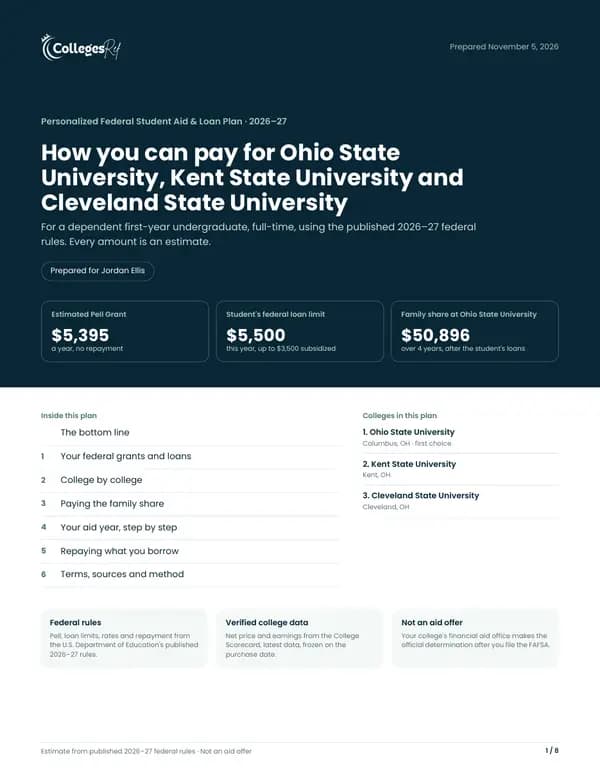
An ROTC scholarship does not automatically disqualify a student from receiving federal student aid. Families must still complete the Free Application for Federal Student Aid (FAFSA) to determine eligibility for need-based grants and federal loans. According to studentaid.gov, the maximum Federal Pell Grant for the 2026-27 award year is $7,395, which can be used to cover living expenses if an ROTC scholarship already covers 100% of tuition and fees.
When coordinating these funding sources, the financial aid office at the chosen college will adjust the student's cost of attendance package. If a student chooses the ROTC room and board option instead of the tuition option, the school will apply those military funds directly to housing and dining charges. For remaining expenses, a dependent student can borrow federal Direct Loans up to annual limits of $5,500 in the first year, $6,500 in the second year, and $7,500 in subsequent years. To ensure proper coordination of these funds, families should request a "financial aid award adjustment review" from the campus financial aid office to confirm that military benefits do not inadvertently reduce other non-federal institutional grants.
Comparing ROTC to Average College Net Prices
Evaluating the financial impact of an ROTC scholarship requires comparing it to the national median net price of $19,835 across all four-year colleges. As shown in the table below, the median in-state tuition at public colleges is $6,089, while the median tuition at private nonprofit colleges reaches $48,600. For a student attending a private nonprofit institution, a full-tuition ROTC scholarship covers a massive financial gap that traditional financial aid rarely meets without heavy borrowing.
Without ROTC funding, a dependent student who borrows the maximum allowable limit of $27,000 over four years would still face significant out-of-pocket costs at these high-tuition schools. For example, at a public institution like Arizona State University Campus Immersion, where the average net price is $14,694, an ROTC scholarship that covers full tuition and fees can eliminate the need for federal loans entirely. Families can compare these figures using a college cost calculator: net price vs sticker price to see how much of their estimated net price can be offset by military benefits.
Colleges in this article

Arizona State University Campus Immersion
Tempe, AZ
- Admit rate
- 90%
- Net price
- $14,694
- Grad rate
- 67%

Texas A & M University-College Station
College Station, TX
- Admit rate
- 57%
- Net price
- $21,527
- Grad rate
- 85%
Federal IPEDS and College Scorecard data on CollegesRef. Net price is the average paid after grants by first-time, full-time students who receive aid.
Using the CollegesRef Directory to Find Host Institutions
Not every college hosts an active ROTC detachment on its campus. Many schools operate under cross-town agreements, which require students to travel to a neighboring host campus for military science classes, physical training, and leadership labs. Before applying for a branch-specific scholarship, applicants must verify where the nearest training unit is located.
Families can search the Financial Aid resources and use the CollegesRef Scholarships directory to identify which of the 1,442 published U.S. colleges host Army, Navy, or Air Force units. When researching potential colleges, students should contact the specific ROTC Recruiting Operations Officer (ROO) at the host institution to ask if the university offers additional campus-specific incentives, such as free room and board for scholarship winners.
| Sector | Colleges | Median net price | Median in-state tuition | Median out-of-state tuition | Median graduation rate | Median earnings (10 yrs) |
|---|---|---|---|---|---|---|
| Public | 1,054 | $10,516 | $6,089 | $12,656 | 42% | $49,519 |
| Private nonprofit | 326 | $27,122 | $48,600 | $48,600 | 70% | $69,642 |
| Private for-profit | 62 | $27,612 | $17,370 | $17,370 | 42% | $45,510 |
Source: CollegesRef analysis of IPEDS and College Scorecard data for 1,442 published U.S. colleges with at least 2,000 students (latest data year 2025). Net price is the average paid by first-time, full-time students who receive grant aid.
At a glance
Average net price for the colleges in this list
- Western Governors University
- $12,748
- Grand Canyon University
- $21,509
ROTC Financial Scenarios: Public, Private, and Reserve Tracks
A student choosing between a public university and a private college
This scenario uses hypothetical household figures to show how ROTC funding alters the math between public and private options. An applicant is accepted to a local public university and a private nonprofit college. The public university has an in-state tuition of $6,089, matching the median in-state tuition for public colleges in the CollegesRef database. The private nonprofit college has a tuition of $48,600, which is the median tuition for private nonprofit colleges in the CollegesRef database. This student receives a four-year Army ROTC scholarship.
First, the student checks how each school treats the ROTC scholarship. The Army ROTC scholarship pays 100% of tuition and mandatory fees at either school, but it does not cover room and board. Second, the student calculates the remaining out-of-pocket costs for housing and food. At the public university, room and board costs $12,000 per year. At the private college, room and board costs $15,000 per year. Third, the student factors in the monthly ROTC living stipend, which is the same at both schools, and subtracts it from the housing costs.
The student chooses the private nonprofit college. Because the ROTC scholarship covers the entire $48,600 private tuition, the massive price gap between the two schools is almost entirely eliminated. The student decides that paying the remaining $15,000 room and board bill at the private college, which has a median graduation rate of 70% in the CollegesRef database, is a better investment than paying $12,000 at the public university, which has a median graduation rate of 42%.
A middle-income applicant using the GRFD track at a public university
This scenario uses hypothetical household figures to evaluate the financial path of a student who wants to remain in their home state after graduation. The student is admitted to Texas A & M University-College Station, which has an average net price of $21,527 according to CollegesRef data. The student does not qualify for a federal Pell Grant, which has a maximum value of $7,395 for the 2026-27 award year according to studentaid.gov. The family cannot afford the net price without borrowing.
First, the student applies for the Guaranteed Reserve Forces Duty (GRFD) scholarship through the Army National Guard. Second, because the GRFD scholarship requires joining the Selected Reserve, the student enlists in the National Guard and begins attending monthly drills. This enlistment allows the student to receive both the GRFD tuition payment and the Montgomery GI Bill Selected Reserve benefits. Third, the student compares the total funding package against the cost of attendance. The GRFD scholarship covers full tuition, while the Guard drill pay and GI Bill stipends cover the remaining room, board, and book expenses.
The student decides to accept the GRFD scholarship at Texas A & M University-College Station. By choosing this path, the student graduates with zero debt, avoiding the need for Direct Loans, which limit dependent undergraduates to $5,500 in their first year according to studentaid.gov. The student also secures a guaranteed commission as an officer in the National Guard, allowing them to start a civilian career in Texas immediately after graduation.
A student using ROTC to avoid high-interest parent loans
This scenario uses hypothetical household figures to show how an ROTC scholarship can protect family finances from federal parent debt. A student is accepted to a private university where the total cost of attendance is $65,000 per year. The university offers a financial aid package that leaves a $25,000 annual gap. To cover this, the family is considering Parent PLUS loans, which are capped at $20,000 per year and $65,000 in total per dependent student for loans first disbursed on or after July 1, 2026, according to studentaid.gov.
First, the student applies for a three-year campus-based Navy ROTC scholarship during their freshman year. Second, for the first year, the student covers the $25,000 gap by taking out the maximum dependent student Direct Loan of $5,500, as permitted by studentaid.gov, while the parents pay the remaining $19,500 out of savings. Third, the Navy ROTC scholarship begins in the sophomore year, covering 100% of the tuition for the remaining three years of college.
The student decides to commit to the Navy ROTC program starting in their sophomore year. By securing the three-year scholarship, the family completely avoids borrowing any Parent PLUS loans. The student graduates with only the initial $5,500 freshman Direct Loan, well below the $27,000 four-year dependent limit set by studentaid.gov, and enters active duty as a Navy Ensign.
You can repeat these steps with your own colleges and compare funding options using the CollegesRef Scholarships directory.