

High school seniors find legitimate college scholarships that actually pay out by applying directly to local civic organizations, regional community foundations, and the financial aid offices of the colleges themselves. National databases contain real awards, but institutional aid and local programs offer the highest probability of success.
This search matters most for students targeting private nonprofit colleges, where CollegesRef data shows a median average net price of $27,122, compared to $10,516 at public institutions. Many families incorrectly assume that private outside scholarships will cover this entire funding gap. In reality, outside awards often trigger a policy called award displacement. Under this rule, a college reduces its own institutional need-based grant by the exact amount of the outside scholarship, leaving the student's final out-of-pocket cost unchanged.
Key takeaways
- Private nonprofit colleges have a median average net price of $27,122, compared to $10,516 at public institutions.
- The national median net price after grants at four-year colleges is $19,835 according to CollegesRef data.
- Outside scholarships can trigger award displacement, where a college reduces its own institutional grant by the award amount.
- First-year dependent undergraduates face a federal Direct Loan limit of $5,500, which often leaves a substantial funding gap.
- For loans disbursed on or after July 1, 2026, federal Parent PLUS borrowing is capped at $20,000 per year.
The Reality of Scholarship Hunting for High School Seniors
High school seniors often spend dozens of hours writing essays for private $500 or $1,000 scholarships, assuming these awards will stack directly on top of their financial aid packages. The reality of funding a college education is different. The largest source of gift aid comes directly from the colleges themselves, not from external foundations or corporate sweepstakes.
Institutional Aid Versus Private Awards
Institutional aid consists of grants and scholarships awarded directly by the college or university. This aid is divided into merit-based awards, which are tied to academic or extracurricular achievements, and need-based grants, which are determined by family income. To estimate these awards before applying, families can use a college cost calculator: net price vs sticker price to see what students with similar financial profiles actually paid in previous years.
Private scholarships, by contrast, come from external entities like local Rotary Clubs, businesses, or national foundations. While these awards help reduce out-of-pocket costs, they rarely match the scale of institutional funding. According to CollegesRef data, the national median net price after grants at four-year colleges is $19,835. For private nonprofit colleges, the median average net price is $27,122, even though their median sticker tuition is $48,600. This massive gap is filled primarily by institutional discount rates, not by outside private awards.
How Colleges Adjust Your Financial Aid Package
When a student wins an outside scholarship, federal regulations require the college to factor that resource into the student's total financial aid package. The total aid from all sources cannot exceed the school's official Cost of Attendance (COA). If a student receives an outside award, the college may reduce other forms of aid to prevent over-packaging. This process is known as scholarship displacement.
To see how a specific campus handles this, a student must locate the school's "outside scholarship policy" on its financial aid website or request it directly from the financial aid office. When reviewing this policy, look specifically for how the school applies outside funds. Some colleges use the outside award to reduce the student's self-help aid first. This means the scholarship replaces student loans or work-study hours, which directly benefits the family.
Other institutions reduce their own institutional grants dollar-for-dollar when an outside scholarship arrives. In this scenario, a $2,000 local scholarship simply saves the college $2,000, leaving the student's out-of-pocket net price completely unchanged. Before applying for external awards, families should email the financial aid office and ask: "If I secure an outside scholarship, does your office apply it first to reduce my student loans and work-study, or will it reduce my institutional grant aid?" Knowing this policy helps students target awards that actually lower their final bill. For more details on navigating these policies, families can explore resources on Financial Aid to understand how different institutions structure their packages.
How to Find Scholarships Through Local and Regional Networks
The High School Counseling Office Resource List
The most direct route to low-competition scholarship funding begins in the guidance office of your own high school. Most counseling departments maintain a physical binder or a shared digital spreadsheet of regional awards. These opportunities are restricted by geography, often limiting eligibility to graduating seniors from a single county or school district.
To access these lists, a student should take the following steps:
- Ask the guidance secretary for the "local scholarship packet" or the "senior awards bulletin" during the fall semester.
- Check if the applications require a specific local form rather than a standard national template.
- Verify if the application requires a copy of the Student Aid Index (SAI) from the FAFSA.
Because these awards are only open to a small pool of applicants, the statistical probability of winning is significantly higher than on national search engines. For families with complex households, understanding FAFSA for Divorced or Separated Parents: Which Parent Files is critical to ensuring the SAI is calculated accurately before submitting these local applications.
Community Foundations and Civic Organizations
Community foundations act as clearinghouses for local philanthropic funds, managing dozens of distinct scholarships through a single portal. A student can locate their regional foundation by searching the Council on Foundations database or by looking up the name of their county alongside the term "community foundation."
These organizations often use a unified application system. By completing one master profile and uploading a high school transcript, an applicant can match with multiple local trusts, memorial funds, and civic scholarships.
Local chapters of the following service clubs host annual essay or community service contests:
- The Rotary Club
- The Elks Lodge
- The Kiwanis
- The American Legion
These groups frequently struggle to attract applicants because they do not advertise on major national search portals. A student should visit the local lodge or post website in January to download the application PDFs directly.
Local Employer and Utility Provider Grants
Local businesses, member-owned utility cooperatives, and regional agricultural associations represent another overlooked source of funding. Electric cooperatives, for example, frequently offer scholarships to high school seniors whose parents or guardians are active members receiving utility services at their home address.
To find these opportunities, families should use the following strategy:
- Review monthly utility bills or visit the website of the local electric, gas, or water provider.
- Prepare the utility account number and write a short essay on community development for the application.
- Ask a parent to contact their Human Resources department to request the "educational benefits policy" document.
The Human Resources document will outline several key details:
- The specific application deadlines
- The eligible majors for the funding
- Whether the funds are paid directly to the college bursar or as a reimbursement to the student
Securing even a few of these small, local grants can dramatically reduce the gap between a college's sticker price vs net price by state, making regional institutions far more affordable.
Navigating National Databases and Avoiding Search Scams
Filtering Out Lead-Generation Sites
National scholarship databases contain thousands of entries, but many operate primarily as lead-generation engines. When a student registers for a free search portal, the platform often sells the student's contact information to test-preparation companies, private student lenders, and marketing firms. To identify these sites, look closely at the registration page for pre-checked consent boxes. These boxes typically grant permission to share data with "educational partners" or "marketing affiliates."
Before entering personal details, locate the site's privacy policy and search for the terms "opt-out" or "third-party disclosure." Legitimate search tools, such as the U.S. Department of Labor’s CareerOneStop scholarship finder, do not require a user profile or password to search their listings. If a database forces a student to input a phone number or social security number to view search results, close the tab. Families can use a free college list builder to identify target institutions first, then search for external awards that specifically target applicants at those specific schools.
Red Flags of Fraudulent Scholarship Offers
Scams often target high school seniors during the peak application season. The most common red flag is any request for an application fee, processing fee, or "disbursement tax." Legitimate scholarship providers never charge a fee to award money.
Be skeptical of organizations that guarantee an award or claim the student has been selected for a scholarship they never applied for. These offers frequently arrive via unsolicited emails or text messages. They often use official-sounding names containing words like "Federal," "National," or "Administration" to mimic government agencies.
If an organization claims a student is a finalist, request their IRS Form 990. Legitimate private foundations must file this form annually, which publicizes their total assets, board members, and actual grant recipients. If the organization cannot provide a physical address, a phone number, or a copy of its annual tax filing, do not submit an application.
Setting Up a Dedicated Application Workflow
Managing dozens of applications requires a secure, organized system that protects personal data. A student should create a separate, professional email address solely for scholarship applications, such as [email protected]. This keeps the student's primary inbox free from marketing spam and ensures deadline reminders do not get lost.
Create a master tracking spreadsheet to monitor every application. The spreadsheet should include columns for the scholarship name, the sponsoring organization, the deadline date, required materials, the award amount, and the date submitted.
| Scholarship Name | Sponsor | Deadline | Required Materials | Award Amount | Date Submitted |
|---|---|---|---|---|---|
| Community Grant | Rotary Club | Feb 15 | Essay, Transcript | $1,000 | Jan 10 |
Before submitting any application, confirm how the organization pays out the funds. Ask the scholarship provider if the check goes directly to the college financial aid office or directly to the student. If the check goes to the college, the financial aid office may reduce the student's institutional aid package. In this scenario, students should learn how to appeal a financial aid offer and when it works to request that the college apply the outside scholarship to their unmet need or self-help aid rather than cutting their institutional grants.
Comparing College Costs and the Impact of Institutional Grants
Analyzing Net Price Across Higher Education Sectors
Families often mistake a large merit scholarship offer for a guarantee of a low out-of-pocket cost. A $20,000 annual scholarship from a private university looks impressive, but if the starting tuition is $48,600, the family still faces a massive funding gap. To find the true cost of attendance, an applicant must calculate the net price by subtracting all grants and scholarships from the total cost of attendance.
This calculation is easier when you compare colleges side by side using their official financial aid award letters. According to CollegesRef data, the national median net price after grants at four-year colleges is $19,835. However, this figure varies dramatically depending on the type of institution.
As shown in the table below, public colleges have a median average net price of $10,516, while private nonprofit colleges carry a median average net price of $27,122. A student attending a private nonprofit institution will, on average, pay over $16,600 more per year than a student attending an in-state public university, even after accounting for institutional aid. For instance, Southern New Hampshire University, a large private nonprofit institution, has an average net price of $36,764, which is significantly higher than the public sector median.
To determine your actual costs before applying, complete the following steps:
- Search each college's website for its Net Price Calculator.
- Input your family's latest federal tax return data and the student's academic profile.
- Receive an estimate of the institutional grants you are likely to receive.
How Graduation Rates and Post-College Earnings Affect Value
Evaluating the true value of a college education requires looking beyond the freshman year net price. A low net price loses its value if a student takes six years to graduate instead of four, or if they struggle to find a high-paying job after graduation. High school seniors should start planning early, even looking at scholarships juniors can win now: contests and awards before 12th grade to build a financial cushion that offsets these long-term costs.
Colleges in this article

Southern New Hampshire University
Manchester, NH
- Admit rate
- 100%
- Net price
- $36,764
- Grad rate
- 42%

Texas A & M University-College Station
College Station, TX
- Admit rate
- 57%
- Net price
- $21,527
- Grad rate
- 85%
Federal IPEDS and College Scorecard data on CollegesRef. Net price is the average paid after grants by first-time, full-time students who receive aid.
The table below reveals a stark contrast in graduation rates and post-college outcomes across sectors. Private nonprofit colleges show a median graduation rate of 70% and median earnings of $69,642 ten years after entry. In contrast, public colleges have a median graduation rate of 42% and median earnings of $49,519. Private for-profit colleges show a median graduation rate of 42% and median earnings of $45,510, yet they carry a high median net price of $27,612.
Before committing to a college, take these steps to evaluate your investment:
- Ask the admissions office for the specific graduation rate of your intended major.
- Request the College Scorecard data for that program to verify the median salary of recent graduates.
If a college has a low graduation rate, a student faces a higher risk of accumulating debt without earning a degree, which completely negates the benefit of any initial scholarship.
| Sector | Colleges | Median net price | Median in-state tuition | Median out-of-state tuition | Median graduation rate | Median earnings (10 yrs) |
|---|---|---|---|---|---|---|
| Public | 1,054 | $10,516 | $6,089 | $12,656 | 42% | $49,519 |
| Private nonprofit | 326 | $27,122 | $48,600 | $48,600 | 70% | $69,642 |
| Private for-profit | 62 | $27,612 | $17,370 | $17,370 | 42% | $45,510 |
Source: CollegesRef analysis of IPEDS and College Scorecard data for 1,442 published U.S. colleges with at least 2,000 students (latest data year 2025). Net price is the average paid by first-time, full-time students who receive grant aid.
At a glance
Average net price for the colleges in this list
- Western Governors University
- $12,748
- Grand Canyon University
- $21,509
Managing Deadlines and the Winter Application Rush
Why Scholarships Due in December Require Early Action
December is the busiest month for scholarship deadlines. Many institutional merit awards require students to submit their complete admissions application by December 1 to qualify for funding. Private foundations often align their deadlines with this date to coordinate with early action admission cycles.
Missing a December deadline by even one hour can disqualify an applicant from thousands of dollars in institutional aid. This is particularly critical when applying to private institutions, where costs are high but aid can be substantial. CollegesRef data shows the national median net price after grants at four-year colleges is $19,835, but at private nonprofit colleges, the median average net price is $27,122.
Students targeting these schools must submit their materials early to access institutional discounts. To find options with lower starting costs, applicants can review the Most Affordable Private Colleges by Net Price (2026).
To manage this window, families should build a master spreadsheet by October. This sheet must track:
- The exact time zone of the deadline.
- Whether the submission portal closes automatically.
- If the scholarship requires a separate application from the main admission portal.
Organizing Letters of Recommendation and Transcripts
High school registrars and teachers face a surge of document requests in November. A student who asks for a transcript or a recommendation letter two weeks before a December deadline risks missing it entirely.
Most high schools require students to submit a formal " brag sheet" or a resume before a counselor will write a letter of recommendation. Request these letters at least four weeks before your earliest deadline. When submitting the request through portals like Common App or a local scholarship drive, confirm the recipient's preferred email address.
For transcripts, check your high school portal for the specific processing form, often called a Transcript Request Form. Note whether the scholarship provider requires an official, sealed transcript sent directly from the school, or if an uploaded, unofficial PDF copy is acceptable. If the provider requires an official paper copy, factor in five to seven business days for postal delivery during the winter holiday rush.
Drafting Reusable Essay Core Modules
Writing a unique essay for every scholarship application is inefficient. Most scholarship prompts focus on a few recurring themes: overcoming an obstacle, defining career goals, or explaining a time of community service.
An applicant can save dozens of hours by drafting three core essay modules during the fall:
- The Personal Narrative (500 words): This module focuses on a specific challenge and the concrete steps taken to resolve it.
- The Academic/Career Goal Statement (250 words): This piece explains how a specific major connects to future employment.
- The Community Impact Story (250 words): This text details a specific service project, including the number of hours served and the measurable outcome.
Once these core modules are polished and proofread, a student can quickly adapt them to fit specific word counts. For a 150-word prompt, the student cuts the 250-word career statement down to its core thesis and active verbs. For a longer prompt, the student combines the personal narrative with the community impact story. Always check the final submission preview to ensure no copy-paste formatting errors remain.
Federal Student Aid Limits and the Funding Gap
Pell Grant Maximums and Eligibility Rules
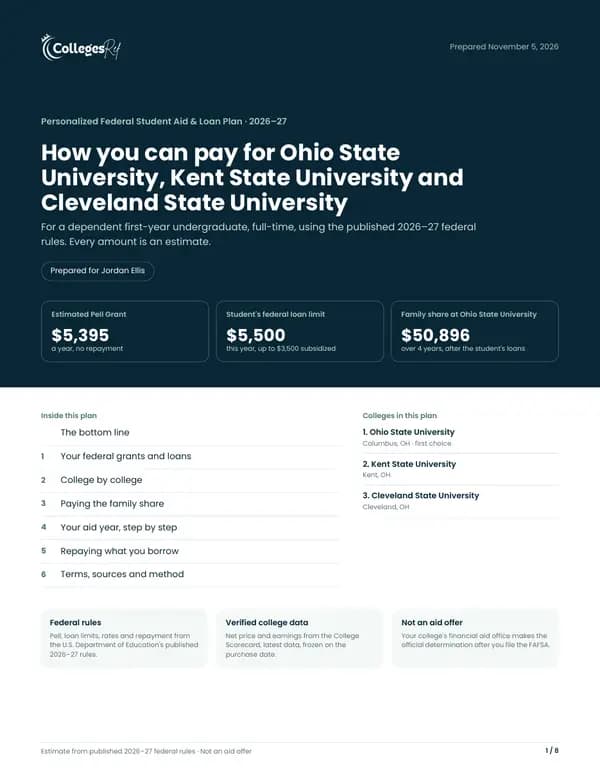
The federal safety net for low-income students begins with the Free Application for Federal Student Aid (FAFSA). This form determines eligibility for the Federal Pell Grant, which does not need to be repaid. According to studentaid.gov, the maximum Federal Pell Grant for the 2026-27 award year is $7,395.
To determine eligibility for these funds, families must evaluate specific criteria on their financial documents:
- Families must look at their Student Aid Index (SAI) on their FAFSA Submission Summary document.
- An SAI of zero or negative numbers down to -1500 typically yields the maximum grant.
However, even the maximum Pell Grant covers only a fraction of college costs. CollegesRef data shows that the national median net price after grants at four-year colleges is $19,835. This leaves a gap of more than $12,400 for a student receiving the maximum Pell award at a median-priced institution.
To find their exact financial shortfall, students should take the following steps:
- Locate the total Cost of Attendance (COA) listed on the financial aid award letter.
- Subtract the federal Pell Grant amount from the COA.
- Subtract any institutional aid from the remaining balance to find the personal funding gap.
Direct Loan Annual Limits for Dependent Undergraduates
When grants do not cover the bill, the federal government offers Direct Loans, but these loans have strict annual caps. According to studentaid.gov, dependent undergraduate students face specific borrowing limits:
- First-year undergraduate students can borrow a maximum of $5,500.
- Only $3,500 of this first-year limit can be in subsidized loans, which do not accrue interest while the student is enrolled.
- Second-year students can borrow an increased maximum of $6,500.
- Third-year students and those beyond can borrow an annual maximum of $7,500.
- Dependent students can borrow a cumulative maximum of $27,000 over four years.
This $5,500 first-year limit rarely covers the remaining balance at most institutions. For example, CollegesRef data shows that private nonprofit colleges have a median average net price of $27,122.
Subtracting the maximum first-year student loan of $5,500 still leaves a funding gap of $21,622 for that first year alone. Families looking to minimize this gap can compare institutions by researching public universities with the lowest out-of-state tuition (2026) to find lower starting baseline costs.
New Caps on Parent PLUS Borrowing
To bridge the remaining gap, families historically turned to federal Parent PLUS loans, which previously allowed borrowing up to the full cost of attendance. Under new federal rules, Parent PLUS borrowing is capped at $20,000 per year and $65,000 in total per dependent student for loans first disbursed on or after July 1, 2026.
This change prevents parents from over-borrowing, but it also creates a hard ceiling on federal financing. If a student attends a private nonprofit college with a median net price of $27,122, the combined maximum of a first-year student loan ($5,500) and the new Parent PLUS limit ($20,000) totals $25,500.
This leaves an immediate annual deficit at a median-priced private college, even with maximum federal borrowing. Families must contact the college financial aid office to ask for a detailed breakdown of the "Net Cost to Family" line on the aid offer to identify these shortfalls before classes begin.
Three Real-World Scenarios of Scholarship Matching and Net Price Outcomes
A first-generation student comparing two in-state offers
All household figures in this scenario are hypothetical. A student from a family with an annual income of $45,000 applies to two public universities in their home state. The student qualifies for the maximum Federal Pell Grant of $7,395, as documented by https://studentaid.gov/understand-aid/types/grants/pell.
- First, the student reviews the financial aid offer from University A, which is a large public institution.
- Second, the student looks at University B, which has a higher net price but offers a local $2,500 community foundation scholarship.
- Third, the student checks the displacement policy at both schools.
The student chooses University B. Because of the favorable outside scholarship policy, the $2,500 award directly reduces the out-of-pocket cost without triggering a reduction in institutional aid.
- CollegesRef data shows the national median net price after grants at four-year colleges is $19,835, but the median average net price for public colleges is lower at $10,516.
- University A offers an institutional need-based grant of $3,000, which, combined with the Pell Grant, brings the student's net price down to $9,500.
- The student secured the local award at University B by submitting a high school transcript and an essay to the regional rotary club.
- University A reduces its institutional grant dollar-for-dollar when outside scholarships are introduced.
- University B allows outside scholarships to reduce the student's self-help expectation first.
An out-of-state applicant managing a private university offer
All household figures in this scenario are hypothetical. A student with a 3.9 GPA and a family income of $115,000 applies to a private nonprofit college. The median average net price for private nonprofit colleges is $27,122 according to CollegesRef data, which is significantly lower than their median in-state and out-of-state tuition of $48,600.
- First, the student receives an acceptance letter with a $15,000 annual merit scholarship from the college.
- Second, the student searches for national scholarships to close the gap.
- Third, the student contacts the financial aid office to see how this award affects their package.
- Fourth, the student calculates the remaining funding gap.
The student decides to enroll. The combination of the $15,000 merit award, the $5,000 national scholarship, and the $5,500 federal student loan brings the family's cash payment down to a manageable level for the first year.
- This merit award reduces the initial tuition cost, but the remaining net price still exceeds the family's budget.
- They apply for and win a $5,000 national corporate scholarship.
- The college applies the $5,000 to the remaining tuition balance rather than reducing the $15,000 merit scholarship.
- Under federal rules outlined at https://studentaid.gov/understand-aid/types/loans/subsidized-unsubsidized, a dependent first-year undergraduate can borrow a maximum of $5,500 in Direct Loans.
A student balancing public university costs and federal loan limits
All household figures in this scenario are hypothetical. A student plans to attend Texas A & M University-College Station as an in-state resident. CollegesRef data shows the average net price at Texas A & M University-College Station is $21,527. The student's family cannot contribute to this cost.
- First, the student completes the FAFSA and receives no Pell Grant because their family income is just above the eligibility threshold.
- Second, the student maximizes their federal student borrowing.
- Third, the student's parent applies for a Parent PLUS loan.
- Fourth, the student applies for local scholarships during their senior winter to cover the remaining balance.
The student decides to attend.
- According to https://studentaid.gov/understand-aid/types/loans/subsidized-unsubsidized, the first-year dependent limit is $5,500.
- This leaves a funding gap of more than $16,000.
- Under the federal rules at https://studentaid.gov/understand-aid/types/loans/plus/parent, Parent PLUS borrowing for loans first disbursed on or after July 1, 2026, is capped at $20,000 per year.
- The parent is approved for a $10,000 loan.