

Returning college students renew their FAFSA online at studentaid.gov each year to secure ongoing federal, state, and institutional financial aid. To maintain eligibility, students must meet their college's Satisfactory Academic Progress (SAP) standards, which require maintaining a minimum GPA and passing a specific percentage of attempted credit hours.
This annual renewal process is critical for the 34% of undergraduates nationally who receive federal Pell Grants, according to CollegesRef 2026–27 edition data. Many families mistakenly assume that financial aid awards automatically roll over from year to year. In reality, a student must submit a new FAFSA for every academic year, and a single semester of poor grades or dropped classes can trigger a financial aid suspension under SAP rules.
Key takeaways
- Returning students must submit a new FAFSA annually at studentaid.gov to secure federal grants, which benefit 34% of undergraduates nationally.
- Federal Pell Grants for the 2026-27 award year max out at $7,395, depending on a student's calculated Student Aid Index.
- Dependent undergraduates face annual federal loan limits that rise from $5,500 in their first year to $7,500 in their third year.
- Students must meet Satisfactory Academic Progress standards, which often require maintaining a minimum GPA and completing a set percentage of credits.
- Private nonprofit colleges have a median in-state tuition of $48,600, making the loss of financial aid through SAP suspension particularly costly.
How to Renew the FAFSA for Returning Students
Federal student aid does not renew automatically. A student must submit a new Free Application for Federal Student Aid (FAFSA) for every academic year they remain enrolled in college. This annual requirement ensures that the federal government, state agencies, and individual campus financial aid offices calculate eligibility based on the most recent financial data.
The Annual Renewal Process on StudentAid.gov
To begin the renewal, a student logs into studentaid.gov using their existing FSA ID. The system pre-fills several demographic fields from the previous year's application, which speeds up the process. The applicant must select the correct academic year form and verify that their personal details, such as permanent address and dependency status, remain accurate.
The student and any required contributors, such as parents or a spouse, must provide consent on the form to retrieve federal tax information directly from the Internal Revenue Service (IRS). This consent allows the direct transfer of tax data, which reduces manual entry errors. If a contributor refuses to provide consent, the student will not be eligible for federal student aid.
Why Your Financial Aid Package Changes Each Year
A student's financial aid package can fluctuate from year to year. Changes in household size, the number of family members enrolled in college, or parental income directly alter the Student Aid Index (SAI). If a parent receives a raise or a sibling graduates from college, the family's calculated financial need may decrease, resulting in fewer grants and more self-help aid like student loans.
Campus-based aid programs, such as Federal Work-Study and Federal Supplemental Educational Opportunity Grants (FSEOG), have limited funding. Even if a student's financial profile remains identical, a college might reduce these awards if its overall federal allocation drops or if the student submits their renewal after the priority deadline.
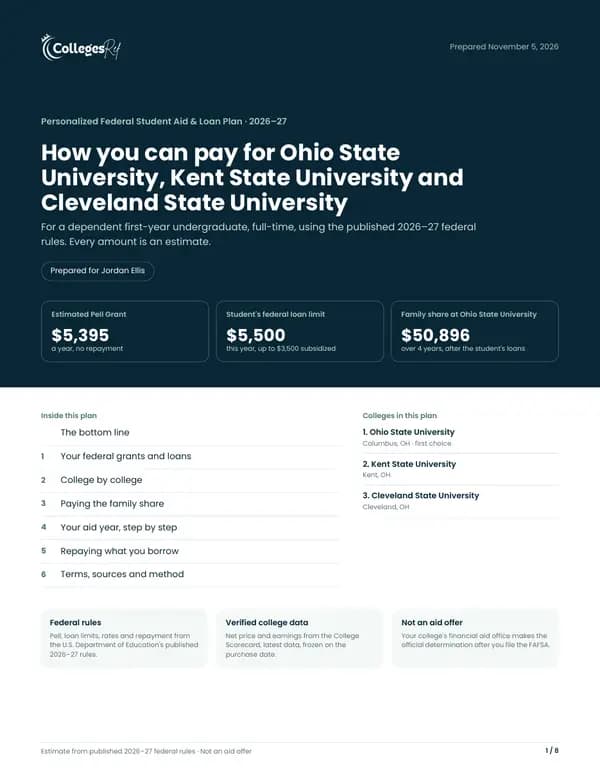
To estimate how these financial shifts might impact federal grant eligibility, families can use the CollegesRef Pell Grant Estimator. This tool provides a quick estimate of federal Pell Grant amounts based on current award rules, though it does not guarantee actual funding or calculate state and institutional awards.
Updating Household and Income Information
The FAFSA requires tax information from the "prior-prior" year. For example, the application for the 2026–27 academic year uses tax data from 2024. If a family's financial situation has deteriorated significantly since that tax year due to a job loss, medical expenses, or divorce, the student must still complete the FAFSA using the requested 2024 tax data.
After submitting the FAFSA, the student must contact the college's financial aid office to request a professional judgment review. The student will need to submit a formal appeal letter along with supporting documentation, such as recent pay stubs, termination letters, or medical bills. The financial aid administrator has the authority to adjust the data elements on the FAFSA to reflect the family's current financial reality. For more detailed guidance on handling these adjustments, students can read about the broader financial aid process on CollegesRef.
Navigating State and College Priority Deadlines
Federal Deadlines vs. Institutional Priority Dates
The federal deadline for submitting the Free Application for Federal Student Aid (FAFSA) is June 30 at the end of the academic award year. Waiting until this summer date is a critical mistake for most returning undergraduates. States and individual colleges establish their own priority deadlines that fall much earlier, typically between January 15 and March 15.
While the federal government processes Pell Grants as entitlement aid for any student who qualifies, state agencies and university financial aid offices operate with finite budgets. If you submit your FAFSA after a state or institutional priority window closes, you remain eligible for federal Pell Grants and federal student loans, but you will likely miss out on state-funded grants and institutional scholarships. You can check the specific state-by-state submission windows on the CollegesRef guide to FAFSA state priority dates to ensure you do not miss these strict cutoffs.
How Early Filing Affects Limited Campus-Based Aid
Colleges receive a set allocation of federal funding each year for campus-based aid programs. These programs include the Federal Supplemental Educational Opportunity Grant (FSEOG) and Federal Work-Study. Once a college distributes its allocated FSEOG and Work-Study funds to early applicants, late applicants receive nothing, regardless of their financial need.
To maximize your chances of securing these limited funds, you must submit your renewal FAFSA as soon as the application opens. Some private institutions also require returning students to submit the CSS Profile annually to renew institutional need-based grants. Because the CSS Profile collects much more detailed asset and household data than the FAFSA, you should review the differences in how colleges evaluate these applications by reading about the CSS Profile vs FAFSA: What Each Form Asks and Who Needs Both. Missing the institutional deadline for either form can result in a revised financial aid package that replaces free institutional grants with additional student loans.
Where to Find Your School's Financial Aid Calendar
Do not rely on general reminders from your academic department or student portal. You must actively locate the official financial aid calendar on your university's website, usually housed under the "Returning Undergraduates" section of the Financial Aid Office page.
Look specifically for the line item labeled "FAFSA Priority Filing Deadline" or "Financial Aid Renewal Date." If the website does not clearly distinguish between deadlines for incoming freshmen and returning students, contact the financial aid office directly. Ask the representative this specific question: "What is the absolute last date a returning student can submit their FAFSA and still receive full consideration for institutional need-based grants and Federal Work-Study?" Write down the name of the representative, the date of your call, and the deadline they provide. Mark this date on your calendar at least two weeks in advance to allow time for resolving any unexpected FSA ID login issues or tax data retrieval errors during submission.
Understanding Satisfactory Academic Progress Financial Aid Rules
Federal financial aid is not guaranteed from one year to the next simply because a student remains enrolled. Under federal law, every college must establish, publish, and apply standards for Satisfactory Academic Progress (SAP). The financial aid office evaluates an academic record at least once a year, often at the end of the spring semester, to determine if a student qualifies for continued federal assistance. This evaluation applies to all federal grants, work-study programs, and direct student loans. According to studentaid.gov, these standards measure three distinct areas of academic performance.
The GPA Requirement: Qualitative Standards
The qualitative standard measures the quality of academic work using a cumulative Grade Point Average (GPA). Federal guidelines generally require a student to have at least a C average, or a 2.0 GPA on a 4.0 scale, by the end of their second academic year. However, individual institutions have the authority to set stricter GPA thresholds for earlier semesters. For example, a college might require a 1.8 GPA after the first semester and a 2.0 GPA thereafter. An applicant can find their current cumulative GPA on an unofficial transcript, which is typically available through the college student portal. If the GPA slips near the threshold, a student should immediately contact an academic advisor to discuss course withdrawal deadlines or grade forgiveness policies before the semester ends. Avoiding common FAFSA mistakes that delay aid will not help if the GPA falls below this institutional baseline.
The Pace Requirement: Quantitative Standards
The quantitative standard measures progress toward graduation by calculating the pace at which a student completes courses. To calculate this pace, divide the cumulative number of credit hours successfully completed by the cumulative number of credit hours attempted. For example, if a student registers for 30 credits in their first year but withdraws from or fails two 3-credit classes, they have completed 24 credits out of 30 attempted. This results in a completion pace of four-fifths of attempted credits. Most colleges require students to maintain a minimum completion pace of 67 percent. This specific percentage ensures that a student can complete a four-year degree within the maximum timeframe allowed for federal aid. Failing, auditing, or withdrawing from classes after the drop-add period counts as attempted but uncompleted hours, which directly lowers the completion pace.
The Maximum Timeframe Rule for Degree Completion
Federal regulations limit the maximum timeframe in which a student can receive financial aid to a set multiple of the published length of the educational program. For a standard 120-credit bachelor's degree, the maximum timeframe is typically 180 attempted credit hours. Every single credit hour attempted counts toward this limit, including transferred credits, repeated courses, and classes dropped after the official census date. Once a student exceeds this credit limit, federal financial aid eligibility ends automatically, even if they are only one class away from graduating. Students who change majors multiple times or pursue multiple minors are at a high risk of exceeding this limit. If a student is approaching this threshold, they must plan remaining semesters carefully to avoid taking on high levels of private debt. Understanding these limits is crucial when evaluating How Much Student Debt Is Too Much? Debt-to-Earnings Benchmarks From Federal Data for a specific major.
What Happens When You Fall Below SAP Standards
The Financial Aid Warning Period
If a student fails to meet the qualitative grade point average or quantitative pace standards at the end of an academic term, the financial aid office does not immediately cut off funding. Instead, the institution places the student on a status known as Financial Aid Warning. According to federal guidelines outlined on studentaid.gov, this warning period lasts for exactly one payment period, which is typically one semester or quarter.
During this warning term, the student continues to receive federal grants and loans. No formal appeal is required to trigger this grace period. It is an automatic administrative status. A student should immediately request an unofficial transcript from the registrar's office to calculate the exact number of credit hours and grade points needed to restore eligibility. For example, if a student completed only 9 out of 15 attempted credits, they must calculate the exact passing rate required in the upcoming term to bring their cumulative completion rate back above the school's minimum threshold, which is commonly 67 percent.
Financial Aid Suspension and Loss of Funding
Failing to restore the required cumulative GPA or pace of completion by the end of the warning period results in Financial Aid Suspension. At this stage, the financial aid office suspends all federal student aid, including Pell Grants, Direct Subsidized and Unsubsidized Loans, and Work-Study funding.
When aid is suspended, the student remains enrolled but must find alternative ways to pay tuition. Some families turn to private loans, which carry different terms than federal options. Understanding federal student loan interest rates and borrowing terms is crucial before taking on higher-cost debt during a suspension. The suspension remains in place until the student either earns enough credits and grade points to meet the minimum standards out of pocket or files a successful written appeal.
How Different College Sectors Handle Academic Progress
The likelihood of facing academic progress issues and the financial consequences of losing aid vary significantly depending on the type of institution a student attends. As shown in the table below, graduation rates and pricing structures differ widely across public, private nonprofit, and private for-profit sectors.
At public universities, where the median graduation rate is 42% according to CollegesRef 2026–27 edition data, students often face larger class sizes and less centralized advising, which can make slipping below SAP standards easier if a student does not closely monitor their own progress. However, because the median in-state tuition at these public schools is $6,089, paying out of pocket for a semester to regain eligibility is more feasible than at private nonprofit institutions.
At private nonprofit colleges, the median in-state tuition rises to $48,600. While these schools boast a much higher median graduation rate of 70%, falling below SAP standards here carries a massive financial penalty. Losing institutional grants at a high-cost school like Southern New Hampshire University, which has an average net price of $36,764, makes continuing education nearly impossible without aid. Families can compare these regional and institutional pricing differences by reading about Sticker Price vs Net Price by State: Where Grants Cut College Costs Most to understand how much aid is actually at stake.
Colleges in this article

Southern New Hampshire University
Manchester, NH
- Admit rate
- 100%
- Net price
- $36,764
- Grad rate
- 42%

Arizona State University Campus Immersion
Tempe, AZ
- Admit rate
- 90%
- Net price
- $14,694
- Grad rate
- 67%

Western Governors University
Salt Lake City, UT
- Admit rate
- —not reported
- Net price
- $12,748
- Grad rate
- 50%
Federal IPEDS and College Scorecard data on CollegesRef. Net price is the average paid after grants by first-time, full-time students who receive aid.
| Sector | Colleges | Median net price | Median in-state tuition | Median out-of-state tuition | Median graduation rate | Median earnings (10 yrs) |
|---|---|---|---|---|---|---|
| Public | 1,054 | $10,516 | $6,089 | $12,656 | 42% | $49,519 |
| Private nonprofit | 326 | $27,122 | $48,600 | $48,600 | 70% | $69,642 |
| Private for-profit | 62 | $27,612 | $17,370 | $17,370 | 42% | $45,510 |
Source: CollegesRef analysis of IPEDS and College Scorecard data for 1,442 published U.S. colleges with at least 2,000 students (latest data year 2025). Net price is the average paid by first-time, full-time students who receive grant aid.
At a glance
Average net price for the colleges in this list
- Western Governors University
- $12,748
- Grand Canyon University
- $21,509
How to Write a Successful SAP Appeal
Documenting Extenuating Circumstances
A student who loses financial aid eligibility due to mitigating circumstances can petition the financial aid office through a formal SAP appeal. Federal regulations outlined on studentaid.gov allow appeals for reasons such as the death of a relative, severe student injury or illness, or other special circumstances. The appeal must explain why the student failed to make academic progress and what has changed in their situation that will allow them to achieve SAP at the next evaluation.
To support the appeal, an applicant must gather objective, third-party documentation. For medical issues, this includes official letters from a licensed physician or copies of medical bills showing the dates of treatment. In the case of a family death, a copy of the death certificate or an obituary is required. If a student experienced housing instability or personal trauma, letters from counselors, social workers, or clergy members on official letterhead serve as valid proof. The financial aid office will reject appeals that lack concrete documentation of the specific dates matching the semesters of poor academic performance.
Drafting the Academic Recovery Plan
The second core component of a successful appeal is a structured academic recovery plan. This plan is a formal agreement showing exactly how the student will meet the minimum GPA and pace requirements by a specific deadline. The student must schedule an appointment with their academic advisor to map out this path.
During this meeting, the advisor and student calculate the exact GPA and credit completion rate needed to regain eligibility. For example, if a student has completed fewer than the required percentage of attempted credits, they must calculate how many consecutive credits they must pass without withdrawing or failing. The resulting recovery plan must list the specific courses the student will take, the tutoring services they will utilize, and the target grades required for each term. Both the student and the academic advisor must sign this document before submission.
Submitting the Appeal to the Financial Aid Office
The completed appeal form, personal statement, supporting documentation, and signed academic recovery plan must be submitted directly to the financial aid office. Students must submit these materials before the institutional priority deadline, which often falls in July for the fall semester or December for the spring semester.
While waiting for a decision, students should prepare for alternative funding options in case the committee denies the appeal. Families can review the federal loan limits to see if additional federal borrowing is an option, or research low-cost institutions using the CollegesRef list of the Most Affordable Private Colleges by Net Price (2026). If the committee approves the appeal, the student is placed on financial aid probation for one payment period. During this probationary semester, the student receives federal aid but must strictly adhere to the terms of their academic recovery plan to keep their funding for subsequent terms.
Annual Borrowing Limits and Grant Estimations for Returning Undergraduates
Direct Loan Limits for Dependent and Independent Students
Federal student loan limits increase as a student earns more credits and advances in grade level. According to studentaid.gov, dependent undergraduate students may borrow up to $5,500 in their first year, $6,500 in their second year, and $7,500 in their third year and beyond. This progression means a dependent undergraduate can borrow a maximum of $27,000 over four years, with an aggregate borrowing limit of $31,000, of which no more than $23,000 may be subsidized.
Independent undergraduates, who do not rely on parental income data on the FAFSA, have access to higher borrowing limits. These students can borrow up to $9,500 in their first year, $10,500 in their second year, and $12,500 in their third year and beyond, up to an aggregate limit of $57,500.
To track your cumulative borrowing against these limits, log into your dashboard on studentaid.gov and download your My Aid data file. Compare your current aggregate total against the limits for your dependency status to ensure you have enough remaining eligibility to complete your degree.
Estimating Your Pell Grant for the Upcoming Year
The maximum Federal Pell Grant for the 2026-27 award year is $7,395, as documented by studentaid.gov. Unlike loans, this need-based aid does not require repayment, making it a critical component of funding for the 34% of undergraduates nationally who receive Pell Grants, according to CollegesRef data.
Your actual Pell Grant award depends on your Student Aid Index (SAI), which is calculated using the financial data you submit on your renewal FAFSA. Families can estimate their upcoming federal grant funding by using the CollegesRef Pell Grant Estimator, which applies the published federal award rules to your financial inputs.
Because Pell Grants are awarded based on financial need rather than institutional budgets, you can use this estimate to plan your payments before your college issues its official financial aid award letter. If your estimated Pell Grant does not cover your remaining costs, you can explore state grant programs to identify additional non-repayable aid options.
Parent PLUS and Graduate Loan Limits
When federal student loans and grants do not cover the total cost of attendance, families often look to additional federal borrowing options. For loans first disbursed on or after July 1, 2026, Parent PLUS borrowing is capped at $20,000 per year and $65,000 in total per dependent student, according to studentaid.gov. This cap requires families to carefully calculate their funding gaps, especially at private nonprofit colleges where the median average net price is $27,122, compared to $10,516 at public colleges.
For students planning to transition into graduate programs, the borrowing rules have changed. For new borrowers from July 1, 2026, Grad PLUS loans end entirely. Instead, graduate students may borrow up to $20,500 a year in Direct Unsubsidized Loans, with a $100,000 aggregate limit. Professional students, such as those in medical or law programs, may borrow up to $50,000 a year, with a $200,000 aggregate limit.
If these federal limits leave a funding gap, students may need to look at lower-cost institutional options, such as Public Universities With the Lowest Out-of-State Tuition (2026), to keep their overall debt manageable.
Real-World Scenarios: Renewing Aid and Managing SAP
A dependent student facing a GPA drop at a public university
A student enters their second year at Arizona State University Campus Immersion, where CollegesRef data shows the average net price is $14,694. This scenario uses hypothetical household figures. The student has a cumulative GPA of 1.8 after a difficult spring semester, falling below the university's required 2.0 minimum GPA standard for Satisfactory Academic Progress (SAP).
First, the student reviews their financial aid portal and finds a notification placing them on financial aid warning for the upcoming autumn term. Because the university allows a one-semester warning period, their federal aid continues without an immediate appeal. Second, the student meets with an academic advisor to map out a course recovery plan, focusing on repeating two classes to replace the low grades. Third, they submit their renewal FAFSA before the state priority deadline to secure potential state grant funding. By earning a 3.0 GPA during the warning semester, the student raises their cumulative GPA to 2.1, successfully meeting the SAP standard and retaining their aid for the spring semester.
An independent student maximizing federal loans after transfer
An independent student transfers to Western Governors University, which has an average net price of $12,748 according to CollegesRef data. This scenario uses hypothetical household figures. The student has already completed 65 credits at a local community college and enters as a third-year undergraduate.
First, the student calculates their remaining federal loan eligibility. According to studentaid.gov, an independent third-year student can borrow up to $12,500 annually in Direct Subsidized and Unsubsidized Loans, compared to the $10,500 limit for second-year students. Second, the student logs into studentaid.gov to complete the renewal FAFSA, ensuring they list the new institution's federal school code. Third, they review their student aid index on the FAFSA Submission Summary to estimate their Federal Pell Grant eligibility, which has a maximum limit of $7,395 for the award year. By confirming their third-year standing with the registrar, the student secures the higher $12,500 loan limit and a prorated Pell Grant, covering their tuition and direct costs without needing private alternative loans.
A dependent student appealing SAP after a medical emergency
A third-year student at Texas A&M University-College Station, where the CollegesRef average net price is $21,527, experiences a severe medical emergency. This scenario uses hypothetical household figures. The student withdraws from three of their four classes in the spring, causing their completion rate to drop to 55%, which is below the university's 67% pace requirement.
First, the student receives an official notice that their financial aid has been suspended. Second, they gather supporting documentation, including a signed letter from their physician confirming the dates of the medical treatment and recovery. Third, the student writes a formal SAP appeal letter explaining how the medical emergency prevented them from completing their coursework and outlines their recovery plan, which includes a reduced course load and weekly tutoring. The financial aid office approves the appeal and places the student on financial aid probation for one semester. This decision allows the student to receive their federal grants and their third-year Direct Loan, capped at $7,500 for a dependent student under studentaid.gov rules, while they work to rebuild their completion pace.
You can estimate your own federal grant eligibility by entering your details into the CollegesRef Pell Grant Estimator.